



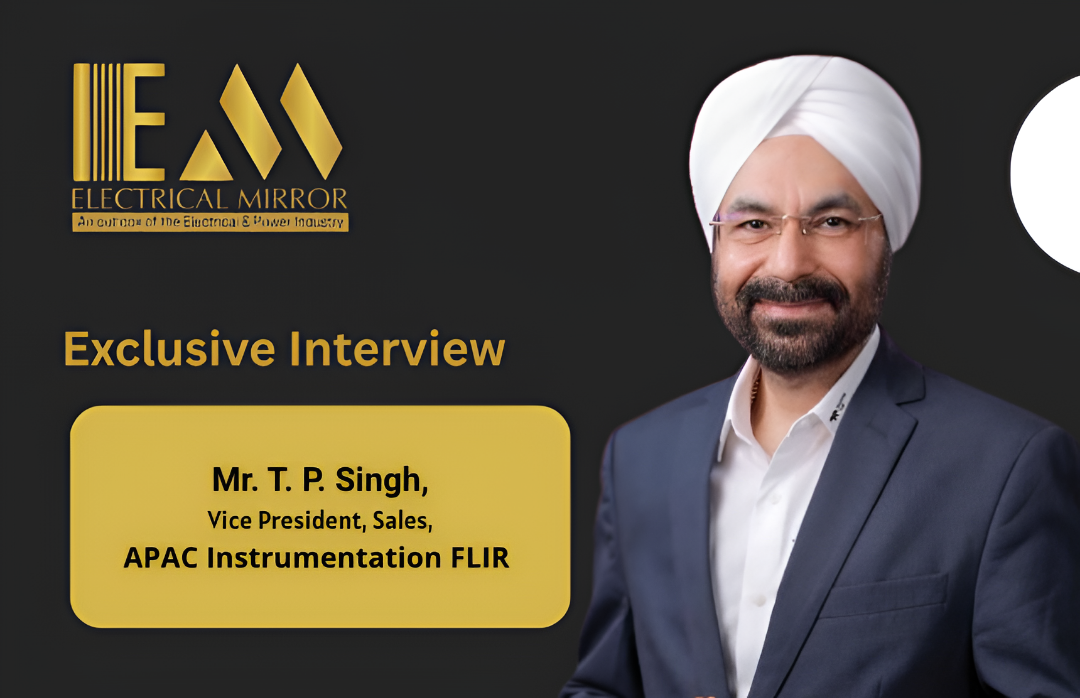
At FLIR, the focus is evolving beyond high-performance cameras to building intelligent, connected ecosystems. By integrating advanced sensing with software, analytics, and AI-driven capabilities, we enable real-time insights that empower faster, smarter decision-making on the ground.
FLIR has evolved from a hardware-focused thermal imaging company into a provider of integrated sensing and AI-driven solutions. How do you define your strategic identity today in an increasingly new advanced imaging ecosystem?
The way, we see our role today has expanded quite significantly beyond traditional hardware. Thermal imaging, in its earlier phase, was largely about capturing temperature data but the expectation from the market has evolved. Today, it’s about how that data can be translated into meaningful, realtime decisions.
At FLIR, this shift is reflected in how we are integrating sensing technologies with software, analytics, and increasingly, AI-led capabilities. Our focus is no longer limited to delivering high performance cameras; it is about creating a more connected and intelligent ecosystem where insights are derived instantly and can directly support operational decision-making in the field. A key aspect of this evolution is making thermal imaging more accessible and intuitive. For instance, with innovations such as our newer mobile-integrated solutions like the FLIR i64, we are bringing advanced thermal capabilities into more compact, user-friendly formats. This allows a much wider range of users, not just specialists, to leverage thermal data in their day-to-day operations.
At the same time, advancements such as routing software, automated workflows, and enhanced analytics are reducing dependency on individual expertise and ensuring more consistent, reliable outcomes. When combined with AI-driven interpretation, this enables faster identification of anomalies and more proactive maintenance strategies. So, in essence, our strategic identity today is centered around enabling a shift from standalone imaging devices to intelligent, data-driven sensing platforms that empower users with clarity, speed, and confidence in their decisions.
Thermal imaging becoming more popularized and competitive globally, what differentiates FLIR’s value proposition beyond hardware especially in terms of data, analytics, and decision intelligence?
It is widely acknowledged that thermal imaging as a technology is becoming increasingly accessible and competitive. However, the real differentiation today lies not in capturing thermal data, but in how effectively that data is structured, interpreted, and translated into actionable outcomes.
A clear reflection of this approach can be seen in solutions like FLIR Assetlink. The idea is to move beyond isolated images and create a connected, asset-centric data environment. Instead of treating inspections as standalone reports, Assetlink automatically links thermal images and sensor data directly to specific assets within a defined hierarchy, which fundamentally changes how information is organised and used. A key distinction here is that the platform follows a assetbased structure rather than a traditional folder based approach, ensuring that all inspection data remains continuously mapped to individual asset and hence makes it easier to access and evaluate.
This enables a much deeper level of insight. For instance, rather than relying on a single snapshot, users can track asset performance over time through trending analysis, identify early-stage anomalies, and adopt predictive maintenance strategies.
The platform also introduces structured workflows and dashboards, ensuring that even less experienced technicians can carry out inspections consistently while decision-makers gain a clear, real-time view of asset health.
Another critical aspect is the elimination of fragmented data and manual reporting. By automating how inspection data is captured, organised, and shared, Assetlink significantly reduces reporting time and improves operational efficiency. More importantly, it allows organisations to transition from reactive maintenance to a more predictive and reliability-focused approach.
So, the differentiation lies in this ability to convert thermal imaging from a diagnostic tool into a decision intelligence system where data is continuously contextualised, analysed, and made accessible across teams. It’s this integration of sensing, analytics, and workflow intelligence that defines our value proposition in today’s increasingly competitive landscape.
Apart from Thermal Imaging, do you have any other new product/ application that you are focused on?
Yes, alongside thermal imaging, we have been actively expanding into complementary technologies, and one of the most significant additions is our range of FLIR Acoustic Imaging Cameras.
This builds on existing inspection practices but introduces an entirely new dimension. While thermal cameras focus on infrared-based condition monitoring, acoustic imaging enables sound-based diagnostics, allowing users to detect issues that are otherwise completely invisible and inaudible.
In industrial and electrical environments, problems such as compressed air leaks or partial discharges emit ultrasonic frequencies that the human ear cannot detect much like infrared radiation cannot be seen. Our acoustic cameras convert these signals into a visual image, precisely identifying the source of the issue through an integrated microphone array and imaging system.
What makes this particularly powerful is the ability to carry out inspections safely from a distance, while also leveraging intelligent analytics to support faster and more accurate fault identification. This not only improves reliability but also significantly reduces inspection time and operational risk.
More importantly, it reinforces our approach of delivering application-led solutions. By combining thermal and acoustic technologies, users gain a more comprehensive view of asset health enabling earlier detection, better decision-making, and ultimately more efficient maintenance strategies.
As India expands toward a more efficient and resilient energy ecosystem spanning renewables, grid modernisation, and industrial electrification, how do you see thermal imaging and advanced sensing technologies contributing to minimising losses, enhancing reliability, and enabling real-time energy intelligence at scale?
This particular technology, in my view, can be used everywhere. If you relate it to our own body whenever something is not right, whether it’s a headache, back pain, or any kind of illness, the first indication is usually that the temperature rises. That’s the first thing we check with a thermometer. Thermal imaging works in exactly the same way.
In any running condition, without taking a shutdown and from a safe distance, you can immediately understand the condition of your assets. Whether it is in electrical utilities, production units, or even in R&D environments, temperature becomes the first and most important indication that something needs attention.
The use of these devices is increasing day by day. And if you look at the way India is progressing and the way industries are expanding, the need for adoption will only increase further. One of the key aspects here is predictive maintenance because before anything fails, temperature is always the first parameter that changes. Since this technology allows you to monitor under live conditions, without interrupting operations, it becomes extremely valuable in ensuring reliability and continuity.
At the same time, there has been a significant shift in perception. Earlier, many people believed this was a high-end technology, limited only to the electrical sector. But that is not the case. It can be used across industries anywhere there is a need to monitor assets and ensure efficiency
Another important factor is accessibility. Around 15/20 years back, these cameras were priced at around 40-50 Lakhs and above, which limited their usage. But today, with increased volumes and advancements in technology, even cameras in the range of around one lakh are available for basic application. This means that people on the field can now easily use these devices at scale, which was not possible earlier.
So, while adoption is increasing, the only gap that remains is awareness. As awareness improves, I believe the use of thermal imaging and advanced sensing technologies will grow significantly.
In the context of India’s journey toward a more efficient and resilient energy ecosystem, these technologies will play a very important role not just in identifying issues, but in minimising losses, improving reliability, and enabling more proactive and intelligent operations across sectors.
From a market standpoint, India presents a unique intersection of rapid infrastructure growth and cost sensitivity. How is FLIR aligning its innovation, partnerships, and localisation strategies to address this dual challenge while unlocking long-term value in the country’s evolving energy and industrial landscape?
Actually, the answer to this is multifold, because it’s a complex question.
The first and most important thing we bring to the table is the quality of the product. Today, there are many thermal cameras available in the market just like any other product category but the real question is about accuracy. It is very easy to say that we have a thermal camera, but it is not easy to deliver highly reliable and precise readings, especially when we are talking about variations as critical as ±1°C.
To put it into perspective, imagine you are using a blood pressure monitor, and it shows your BP as 120, whereas in reality it is 200. The device exists, but the reading is not dependable. The same applies here. In field conditions, if the camera is not properly calibrated or does not deliver accurate readings, it can lead to completely incorrect decisions. So, the most critical aspect is not just having a device, but having a device you can trust.
That’s where FLIR differentiates itself. We have been in this field for more than 60 years, continuously innovating and developing this technology. In fact, we were among the pioneers who introduced thermal imaging in the first place. Over time, many companies have entered the space, and while replication is easy, maintaining consistent quality and accuracy is not.
The second key pillar is innovation. Our approach has always been to continuously evolve the technology whether through better sensors, improved software integration, or more applicationdriven solutions so that users can derive maximum value in real-world scenarios.
From a long-term perspective, another important aspect is trust and commitment. We offer a 10-year warranty on our detectors, which is quite unique in this industry. This is only possible because we are confident in the quality and durability of our products, and it also reflects our long-term commitment to the market.
In addition to this, we have built a strong local presence across India. We have service centre in Delhi and trained representatives across states who support customers both before and after the purchase. It is easy to claim nationwide support, but we take pride in actually delivering that ensuring that users are guided, trained, and supported throughout their journey.
So, if I have to summarise, our approach to a market like India where there is both rapid growth and cost sensitivity is centred around delivering uncompromised quality, continuous innovation, and long-term reliability, backed by strong local support. These are the key elements that allow us to create sustained value in the country’s evolving energy and industrial landscape.
