



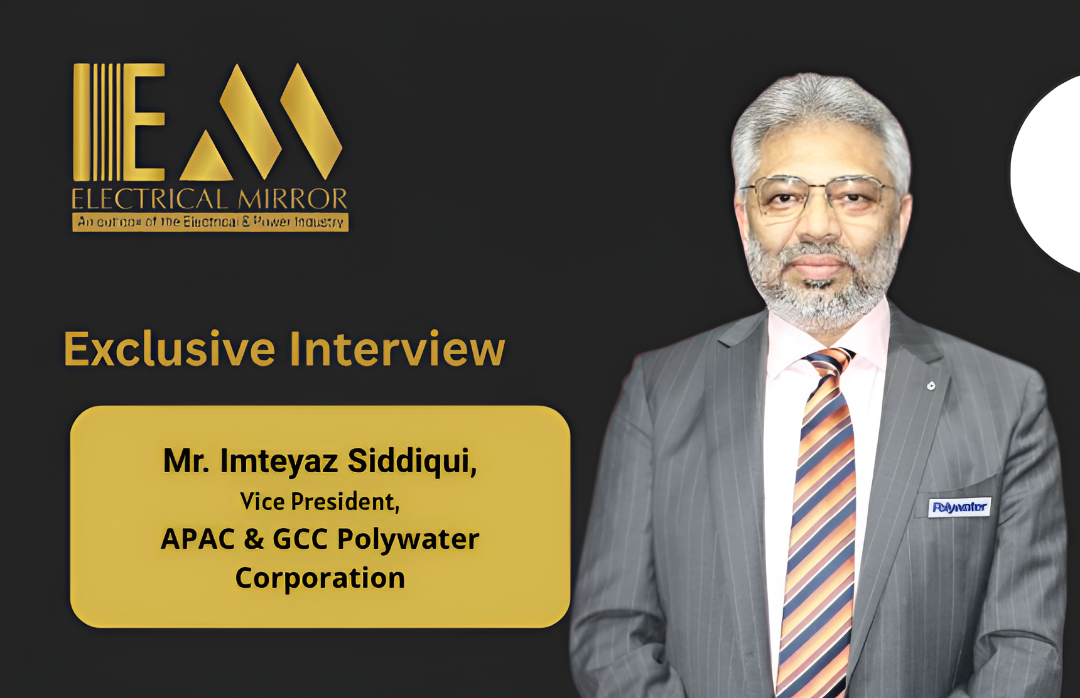
Polywater’s mission is very simple: make infrastructure work better, last longer, and cost less to maintain. For over five decades, we have focused on the critical chemistry between the cable and the conduit, what we call specialty chemicals for the electrical and communications industry. Our priorities are clear: installation quality determines asset longevity, solutions must be engineered for local conditions, and markets like India, Southeast Asia, and the GCC deserve deep technical engagement.
How does the company define its core mission, and what are its key strategic priorities in the global electrical and communications sectors?
Polywater’s mission is very simple: make infrastructure work better, last longer, and cost less to maintain. For over five decades, we have focused on the unglamorous but absolutely critical chemistry that sits between the cable and the conduit, between the duct and the outside world. We call it specialty chemicals for the electrical and communications industry – the world calls it essential.
Our strategic priorities are anchored in three strong convictions. First, that installation quality determines asset longevity – and our cable-pulling lubricants, friction-reduction tools like PullPlanner, and conduit sealants directly address that requirement. Second, that infrastructure owners deserve products engineered for their specific local conditions, i.e. climate, soil type, voltage class, and installation method. One-size-fits-all is a myth we actively resist. Third, that markets like India, Southeast Asia, and the GCC are no longer emerging markets; they have arrived. They deserve the same depth of technical engagement that we provide in North America or Europe.
From Polywater UAE, we operate across more than 20 countries spanning the Gulf to the Pacific. Every market teaches us something. We bring that learning back into our products, our training, and our partnerships. That loop of learning and improving, and that is the Polywater way.
What emerging technologies is the company currently exploring to enhance or support future infrastructure development?
Technology, for us, is not just what goes into the product; it is what the product enables. And right now, three frontiers are shaping our R&D and goto-market thinking. The first is digital installation intelligence. PullPlanner, our proprietary cable-pulling calculation software, uses real friction coefficients measured in our labs to predict pull tension with remarkable accuracy, saving contractors from undersizing equipment or damaging cables during installation. We are continuously expanding our database and exploring integration with project management and BIM platforms.
The second is foam-based sealing technology. Our Foam Sealant Technology (FST) addresses one of the most persistent vulnerabilities in underground infrastructure: water, gas, and pest infiltration through ducts. With data centres, urban cable networks, and renewable energy installations requiring zero tolerance for infiltration, FST is becoming a critical specification item. The technology is elegant in its simplicity and rigorous in its performance. The third is the chemistry of solar panel maintenance. As solar installations scale globally, particularly in APAC and the GCC, where dust and soiling are severe, panel wash efficiency becomes a revenue-critical variable. Our Solar Panel Wash chemistry is designed for high-efficiency cleaning with minimal water use. In water-scarce markets like the Middle East, that is not just a product feature. It is a market imperative.
How do key global macro trends, infrastructure expansion, renewable energy adoption, and digital communications upgrades influence your projections for future product demand?
I have been in the power sector for over 34 years now. I have seen trends come and go. But what is happening right now is not a trend – it is a structural reset of global infrastructure. And for a company like Polywater, that reset translates into demand across every product line we make. India alone is investing at a scale that would have seemed ambitious even a decade ago: transmission corridors, solar parks, data centre campuses, 5G rollouts, metro rail networks. Every one of these projects involves cabling. And every cable installation involves the question of friction, sealing, and longevity. That is our space.
Renewable energy brings a particular nuance. Solar and wind installations are often in remote, harsh environments, desert terrain, offshore platforms, and mountainous regions. Cables have to survive not just installation stress but also years of thermal cycling, moisture ingress, and mechanical fatigue. Our lubricants and sealants are specifically engineered for these conditions.
The data centre boom is equally significant. These are mission-critical environments. A compromised duct seal or a cable damaged during pull-in is not just a maintenance issue; it can trigger downtime worth millions. Buyers in this segment are moving from price-first to performance-first. That shift plays directly to our strength. Our forward projection is bullish and grounded in engineering reality.
What have been the most significant challenges your company has faced in scaling its products and services in international markets, and how have you addressed them?
Let me be honest – international scaling requires patience and persistence. Not because our products are difficult to understand, but because infrastructure development habits are deeply local. Engineers in India install cables differently from engineers in Australia or Saudi Arabia. Conduit standards differ. Voltage classes differ. Even what a ‘good installation’ looks like differs.
The first challenge was relevance. We had to demonstrate that our products were designed for local conditions, not simply exported from a North American context. We addressed this by building a regional entity, Polywater UAE, with on-the-ground presence, technical application expertise, and the authority to adapt messaging, documentation, and training to local needs.
The second challenge is specification inertia. In many markets, there is no tradition of specifying cable-pulling lubricants or duct sealants by performance standards. Contractors use whatever is available, or nothing at all. We have had to invest in education, including technical seminars, conference papers, standards engagement, etc., to initiate the right conversation.
The third is the distributor/channel partner ecosystem. Appointing a distributor is easy. Building a partner who can articulate the technical value of our products in the local language to the right buyer takes years. We have been deliberate and sometimes slow in this, but the partnerships we have built across APAC and GCC are deep and durable. That patience has paid dividends.
.In what way does attending an exhibition advance the company’s marketing goals and build strategic partnerships?
Participation in any exhibition is not just a marketing exercise for us, but also an intelligence mission. It helps us understand where the market is heading, who the decision-makers are, what problems they are trying to solve, and then we position ourselves as part of the solution. India’s electrical industry is growing rapidly, requiring face-to-face engagement. A brochure or a LinkedIn post can describe our products. But a conversation on the show floor, where an EPC project manager asks, ‘Can your lubricant handle a 500-metre horizontal pull in a 110mm HDPE duct?’ is where real partnerships are forged. We can answer that question with data, with Pull-Planner simulation outputs, and with case studies. That depth of response builds trust instantly.
The concentration of decision-makers in one venue, over two or three days, is extraordinarily efficient for business development. We use the platform not just to show products but to conduct application conversations, identify specification opportunities, and meet our distributor partners in person.
In exhibitions, which often also include conferences or speaking slots, we focus on narrative impact. Was our brand visible in the conference media? Were our spokespeople featured in panel discussions or editorial coverage? Did we leave the event having strengthened Polywater’s identity as a technically serious, application-focused partner, not just another product company?
These event lets us signal that commitment publicly. When customers and partners see us present, engaged, and technically prepared, it reinforces a simple message: Polywater is here for the long haul. That signal is itself a competitive advantage
Can you share the company’s strategic focus regarding new product categories or market segments for near-term growth?
Near-term, our strategic focus converges on two vectors: new applications within existing product lines, and new segments that our chemistry is naturally suited to serve.
Among applications, data centres are our highestpriority emerging segment. The density of cabling inside a modern hyperscale data centre, combined with the zero-tolerance for installation error or duct compromise, makes every Polywater product relevant. Cable-pulling lubricants for structured cabling and power feeds, FST for fire-stopping and environmental sealing, PowerPatch for rapid duct repair – fit is natural & precise. We are developing application guides, specification templates, and training programmes specifically for the data centre contractor community. Considering geography, Asia is our next frontier. Vietnam, the Philippines, Indonesia, and Malaysia are all in active market development mode. These are large, fast-growing economies with expanding power infrastructure and nascent but rapidly professionalising cable installation practices. Being present early, building distributor partnerships, and establishing technical credibility before the market matures is our mantra.
In terms of segments, the renewable energy sector, particularly solar, is a natural adjacency given the scale of installations across APAC and GCC. And within the GCC, we are expanding beyond cable installation into repair and maintenance chemistry, addressing the lifecycle of installed infrastructure rather than just the initial installation. Growth, for us, is never accidental. It is engineered.
Looking toward the next decade, how does the company plan to advance global infrastructure resilience and sustainability, and what role does it envision playing in shaping these priorities?
A decade from now, the world’s infrastructure will be more interconnected, more digital, more renewable, and hence more vulnerable to failure if not installed and maintained with discipline. That vulnerability is our opportunity, and our responsibility.
Polywater’s role in resilience is straightforward: every cable must be installed correctly, every duct must be sealed properly, and every joint should be protected from moisture and mechanical stress. These are the building blocks of grid reliability. We intend to be the company that sets the global standard for installation chemistry, the one whose name is synonymous with getting the job done right
On sustainability, we are deepening our commitment at every level. Formulation chemistry is evolving toward biodegradable lubricants, lower-VOC sealants, and products that reduce on-site waste. Our Solar Panel Wash is a direct contribution to solar energy efficiency. And PullPlanner, by optimizing cable pulls, reduces rework, thereby reducing material waste and the project’s carbon footprint.
But perhaps our most important contribution to sustainability is the most intangible: longevity. Infrastructure that is installed correctly lasts longer. It consumes fewer replacement resources. It demands less maintenance energy. That is the sustainability argument no one talks about enough: it is the one Polywater has been making through its products for over 50 years. The next decade will validate everything we believe in. We are ready!
