



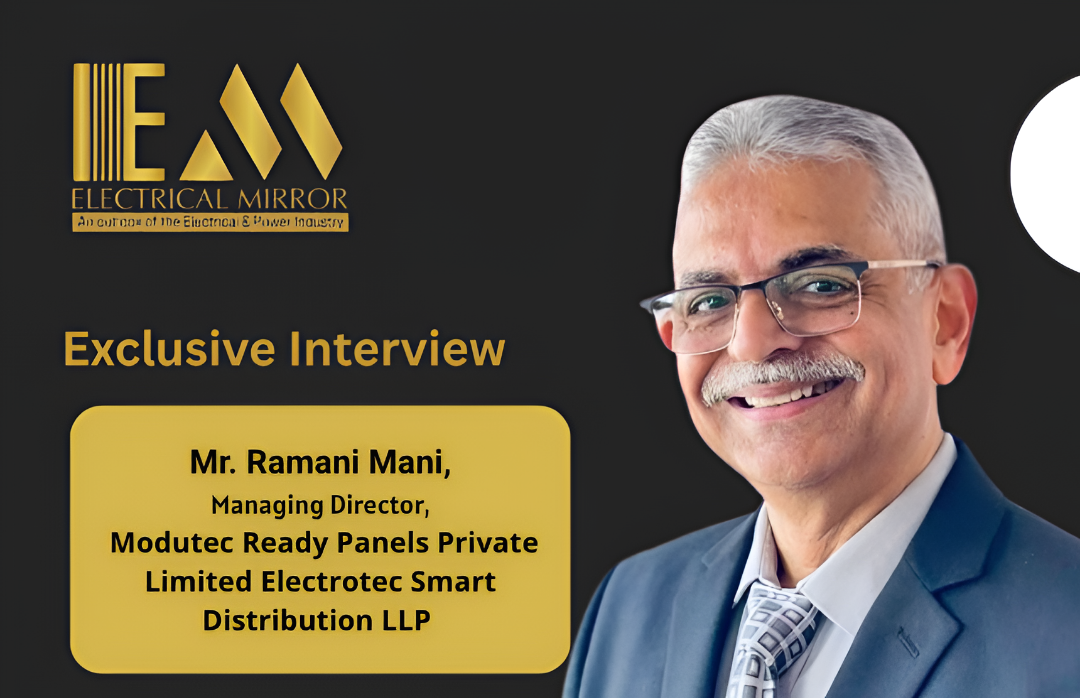
“We believe the future belongs to organisations that empower their ecosystem to grow, rather than merely supply to it. That’s aligned with our mission of “Simplifying Panel Building to scale.”
The evolution of panel building has long been defined by incremental engineering improvements. Yet the emergence of modular architectures suggests a more fundamental shift. How do you interpret this transition as an efficiency upgrade, or as a structural rethinking of how panels are conceived, built, and deployed?
I’m reminded of the times when the wheel was invented. On the same lines, the transition to modular architecture is not merely an efficiency upgrade—it is a fundamental rethinking of the panel building paradigm.
For decades, the industry has optimised within the constraints of welded construction—improving processes, refining fabrication, and enhancing assembly techniques. However, modularity challenges the very starting point of design philosophy, as it did for me when I first saw a truly world class modular technology for the first time in my career in Singapore way back in 1996. It shifted my focus from how to build better panels to how to build panels better!
At Modutec, we see this as moving from a craftbased, fabrication-driven model to a systemdriven, engineering-led approach. Modular architecture decouples mechanical complexity from electrical integration, enabling standardisation, scalability, and predictability. This is not evolution and I hope the Panel Building fraternity are listening—it is transformation!
Conventional welded enclosures have dominated the industry for decades, despite inherent limitations in logistics, scalability, and flexibility. In challenging this paradigm, what underlying inefficiencies is your modular, flat-pack approach designed to resolve at a systemic level?
Welded enclosures have served the industry well, but they carry inherent inefficiencies that are often accepted as unavoidable. And this is sheer lack of knowledge, I feel. The pain points are:
- Logistical inefficiency due to bulky, fully assembled structures
- Inflexibility once fabrication is complete
- High rework risk during late-stage design changes
- Dependence on skilled welding and fabrication infrastructure
- Limited scalability and standardisation Our modular, flat-pack approach addresses these at a systemic level
By enabling knock-down logistics, we dramatically reduce transportation costs and damage risks.
By introducing design standardisation with flexibility, we allow changes even at advanced stages without scrapping work. Most importantly, we shift panel builders from being fabricators of metal to integrators of engineered systems!
Project timelines across infrastructure and industrial sectors are tightening significantly. In this context, how does a modular ecosystem enable panel builders to move beyond bespoke execution toward a more standardised, repeatable, and time-efficient manufacturing model?
Oh! I remember the time 8 years ago, when I was handed down a PO for electrical switchboards in my Control Panel industry for a value equal to my previous year’s turnover. And I had to execute within 5 months! This was the time, I truly realised the value of a modular design of switchboard enclosures. The major reason why and how we were able to complete this project to the satisfaction of all stakeholders was our modular enclosures.
Today most projects demand speed—not at the cost of quality, but through intelligent design frameworks. And this is where a modular ecosystem enables panel builders to move away from starting from the drawing board for every project. Instead, they operate within a pre-engineered, type-tested design envelope, where:
- Engineering time is drastically reduced
- Assembly becomes predictable and faster
- Training requirements are simplified
- Execution becomes repeatable across geographies and teams
At Modutec, our goal is to help panel builders transition from project-based execution to processdriven manufacturing, where speed is a byproduct of clarity and structure!
Regulatory frameworks such as IEC 61439 have redefined expectations around safety and performance. How do your type-tested modular systems transform compliance from a procedural requirement into a strategic differentiator for panel builders and OEM partners?
Trust has always been the selling point, especially in a safety and compliance oriented industry like electrical panels. To augment stakeholder confidence in a project, IEC 61439 has elevated the conversation from mere assembly to verified performance and accountability.
However, compliance is often treated as a checkbox—something to be documented rather than demonstrated. At Modutec, we see compliance as a strategic differentiator.
We are the most extensively type-tested modular system of Indian origin, validated across multiple configurations, conditions & switchgear, NABL approved test laboratories in India and overseas and testing & certifying agencies like CPRI, ERDA, ASTA & DEKRA. This enables our Modutec partners to:
- Offer confidence-backed solutions to consultants and end users
- Be switchgear agnostic and focus more on choices so that project timelines are met
- Reduce ambiguity in design validation
- Strengthen their credibility in high-value, safetycritical projects
- Issue a Modutec certified “Declaration of Conformity” project wise
Compliance, when embedded into the system design, becomes a business advantage—not a burden. And Modutec hand holds its partners in this regard, proactively and comprehensively !
The industry is increasingly shifting from component-driven supply to solution-oriented ecosystems. How is Modutec shaping its role within this transition not merely as a manufacturer, but as a facilitator of design integration, capability building, and long-term partner value?
Quite early in my entrepreneurial journey, I realised that my business has to move from selling just products to solutions, and from transactions to partnerships.
At Modutec, we consciously position ourselves not just as a manufacturer, but as a capability enabler. Our role extends into:
- Design integration support through modular engineering frameworks
- Capability building via programs like PARTTEC & MODHUB
- Digital enablement through software platforms like MODEST
- Market alignment by supporting partners in targeting their right customer segments
- Empower a Customer Experience Center in Partner locations to aid clarity in offerings.
We believe the future belongs to organisations that empower their ecosystem to grow, rather than merely supply to it. That’s aligned with our mission of “Simplifying Panel Building to scale”
As electrical distribution systems grow more complex, decentralised, and time-sensitive, what will ultimately distinguish leaders in panel building incremental gains in manufacturing efficiency, or the ability to redefine the underlying design and delivery philosophy of the entire system?
The leaders in panel building will be the ones who imagine their tomorrow, today and follow the writings on the wall, which task masters do not find the time to read. Achieving marginal gains in efficiency should be replaced with purposefulness, missionary zeal and audacious goals. I think our Country and the world needs these now, more than they ever did it in the past
As electrical systems become more complex, decentralised, and time-sensitive, success will depend on:
- Clarity of design thinking, and in our case modular thinking like a LEGO or an IKEA
- Standardisation without rigidity
- Presenting our product solutions with flexibility, adaptability and versatility
- Speed without compromise
- Integration across different categories of stakeholders
In essence, the winners will be those who transition from being panel builders to solution architects of electrical distribution systems. Adding differentiated value & proactive answers to the constraints being faced by our Customer’s Customer is the Key!
At Modutec, our mission—Simplifying Panel Building—is rooted in this belief. Because when complexity is simplified at the source, speed, safety, and scalability naturally follow.
