



The Stark Reality of Electrical Accidents
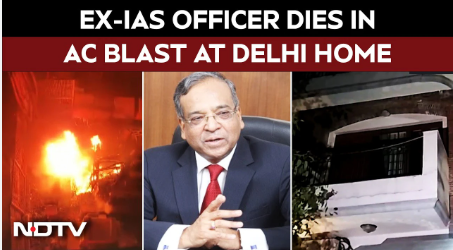
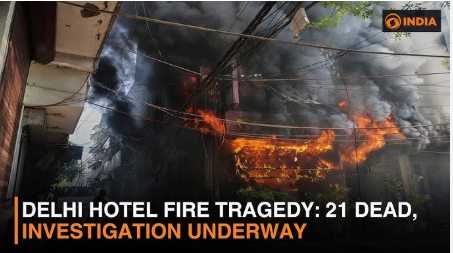
Delhi has witnessed severe fire tragedies recently, highlighting critical gaps in urban infrastructure and safety compliance. In South Delhi, a tragic air conditioner compressor blast led to a devastating fire at the residence of retired IAS officer Dhanendra Kumar, resulting in his untimely demise from smoke inhalation and severe injuries. Meanwhile, a massive blaze broke out in the residential area of Indira Vihar, where narrow lanes and dense construction severely hampered emergency rescue operations. Most recently, a horrific fire ravaged a hotel in Malviya Nagar, claiming at least 21 lives—including several foreign nationals. This article evaluates Delhi’s recent fire disasters and provides actionable insights to strengthen fire safety compliance and prevent future tragedies in high-risk zones.
INTRODUCTION
Every single day, an invisible crisis unfolds across the Indian landscape. According to the National Crime Records Bureau (NCRB), approximately 40 lives are cut short daily due to electrical accident and electrical fire—with a staggering and consistent percentage of these tragedies rooted in electrical short circuits and faults. What was once considered an isolated technical hazard has transformed into a national public safety emergency.
As urban centers rapidly expand, infrastructure density intensifies, and consumer demand for high-power electrical appliances surges, our indoor environments are transitioning into hotbeds for electrical mishaps. The recent, deeply harrowing incidents across Delhi serve as a grim reminder that electrical fires do not discriminate; they strike residential hubs, bustling commercial complexes, and premium enclaves alike.
Electrocution, Electrical fire and Lightning kill 15,000 a year. Also 75000 (approx.) suffer because of these deaths, there is loss of property and assets, dreams of many people associated with deceased shatter.
Electrical fires in electrical installation may be broadly caused by
- Over currents (overloads and short circuits)
- Harmonics
- Earth fault
- Electric arcs in cables and loose Connections
- Failure of protection device or Wrong selection of protection device
- Wrong selection of cables or wires
- Mismatch of illumination fittings rating and lamps used
- Use of extension cord for heaters or any other heavy loads
- Use of outlived (outdated) or damaged equipments
- Over voltages (Lightning ) & arcing ground
- Consumer has become prosumer
- Inadequate design for earthing / grounding
- Improper or No verification and testing (commissioning or periodical)
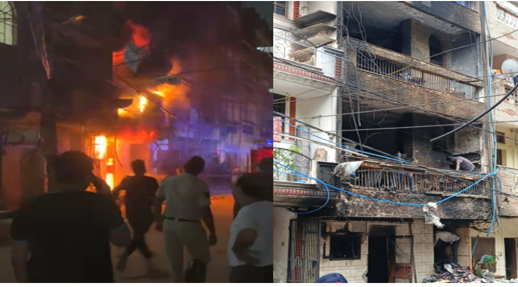
2.0 Lessons from the Ground: Recent Delhi Tragedies
Analyzing recent, devastating incidents in the national capital reveals a critical pattern: our current safety margins are failing to keep pace with modern electrical loads.
- The Hauz Khas Tragedy (May 2026): The vulnerability of domestic setups was tragically highlighted when an 80-year-old retired IAS officer, Dhanendra Kumar (former Chairman of the Competition Commission of India), succumbed to smoke inhalation. The fire was triggered by a suspected explosion and short circuit in the indoor unit of an air conditioner. Prolonged usage during extreme summer peaks leads to severe overheating, insulation degradation, and catastrophic failure when protective gear fails to isolate the circuit instantly.
- The Malviya Nagar & Indira Vihar Disasters: Recent commercial and residential fires in dense urban pockets like Malviya Nagar and near student hubs like Indira Vihar underscore a different facet of the crisis: rapid infrastructural expansion without proportional upgrades to electrical distribution network and safety methods . Overloaded circuits, substandard wiring, and the absence of localized earth-leakage protection turn minor faults into raging, uncontrollable infernos within minutes.
To prevent our homes and workplaces from turning into fire traps, a absolute adherence to Indian Standard (IS) codes and statutory regulations is required.
3.0 Regulatory Framework and Statutory Mandates
The roadmap to absolute electrical safety is already legally defined in India. It requires strict compliance with the Central Electricity Authority (CEA) Safety Regulations 2023 and the National Electrical Code (NEC).
The CEA Regulations explicitly mandate that no electrical installation should be energized or maintained without adequate protective devices that can isolate a fault within milliseconds. Furthermore, standards such as IS 732 (Code of Practice for Electrical Installations) lay down rigid criteria for wire sizing, continuous conductor continuity, and systematic thermal calculations to ensure that cables do not degrade under peak continuous loads.
4.0 The Critical Shield: Life-Saving Application of RCDs
The single most effective intervention to stop electrical fires and electrocutions before they begin is the statutory integration of a Residual Current Device (RCD), universally implemented via Residual Current Circuit Breakers (RCCBs) or Residual Current Breakers with Overcurrent Protection (RCBOs) as per IS 12640.
An RCD operates on the principle of current balance. It continuously monitors the vector sum of currents flowing through the phase and neutral conductors via a Core Balance Current Transformer (CBCT).
1. Fire Protection (100mA to 300mA Sensitivity)
When insulation breaks down due to aging, rodent damage, or overheating, a persistent current leaks into the surrounding structural environment (earth). A leakage of just 300 mA sustained over an organic or combustible surface is thermally sufficient to ignite a fire. Installing a 100mA or 300mA sensitivity RCCB at the main incomer panel ensures that any tracking or stray earth-fault current instantly trips the main supply, eliminating the primary source of electrical ignition.
2. Human Shock Protection (30mA Sensitivity)
For final sub-circuits, especially those feeding plug points, home appliances, and moisture-prone areas (kitchens and bathrooms), IS 12640-1 mandates a sensitivity of strictly 30mA. If a human comes into direct contact with a live wire, or an appliance chassis becomes energized, the RCCB detects the minor current imbalance and disconnects the circuit within 30 milliseconds, well before ventricular fibrillation or fatal shock can occur.
5.0 Selecting the Accurate Type of MCB
A common, dangerous misconception in Indian households is that a standard Miniature Circuit Breaker (MCB) protects against all electrical anomalies. An MCB only protects against Overloads (via a bimetallic strip) and Short Circuits (via a magnetic coil). It offers zero protection against low-level earth leakages.
Furthermore, selecting an incorrect MCB tripping characteristic curve creates a severe fire hazard by either causing frequent nuisance tripping or failing to trip during a critical fault. As per standard engineering practices, MCBs must be classified and matched precisely to the load type:
| MCB Type | Tripping Current Range | Ideal Practical Application | Reason for Selection |
| Type B | 3I_n to 5I_n | Residential lighting, resistive heating, general domestic wiring. | Low surge currents; trips quickly on minor faults to protect standard PVC wires. |
| Type C | 5I_n to 10I_n | Air Conditioners, refrigerators, water pumps, inductive loads. | Accommodates the high initial inrush current of compressor motors without nuisance tripping, yet offers robust short-circuit defense. |
| Type D | 10I_n to 20I_n | Industrial transformers, large winding motors, X-ray machines. | Designed for heavy industrial equipment with massive inductive surges. Never use in domestic settings. |
Using a Type D or oversized Type C breaker on a standard domestic circuit means that during a short circuit, the fault current may not reach the high threshold required for instantaneous magnetic tripping. The wire will continue to cook and melt its insulation, leading to a catastrophic structural fire.
6.0 The Foundational Pillar: Why Adequate Earthing is Critical for Protection Devices
While RCDs and MCBs are highly sophisticated safety devices, their ability to protect lives and property depends heavily on a robust, low-impedance earthing system. Without proper earthing, even the highest-quality protective switchgear can be rendered completely useless, leaving a facility vulnerable to catastrophic fires and fatal shocks.
1. Enabling the RCD to Detect Faults Before Human Contact
The primary job of a Residual Current Device (RCD) is to sense a current imbalance between the phase and neutral wires. If a fault occurs inside an appliance (such as an air conditioner or refrigerator) and the live internal wire touches the metallic chassis, two completely different scenarios unfold based on the quality of the earthing system:
- Scenario A: Effective, Low-Impedance Earthing (Safe Setup):
The moment the insulation fails and the live conductor touches the grounded metal enclosure, current instantly rushes down the low-resistance earth continuity conductor back to the source. The RCD immediately senses this missing current (as the phase current no longer equals the neutral current) and trips the circuit instantly. The hazard is isolated before anyone ever touches the machine.
- Scenario B: Poor or Missing Earthing (The Trap):
If the earthing is broken, corroded, or missing, the leakage current has no path to flow. The metallic chassis becomes fully energized at 230V, but the current balancing mechanism inside the RCD sees no discrepancy because no current is leaking out yet. The appliance sits there silently energized. The moment an unsuspecting person touches the chassis, their body becomes the missing earth path. While a 30mA RCD will still trip to save their life, the person will experience a painful, highly dangerous shock that should have been prevented entirely by adequate earthing.
2. Triggering Magnetic Short-Circuit Tripping in MCBs
As established under the precise selection of MCB characteristic curves (Type B and Type C), an MCB relies on a high magnetic surge current to trip instantly (3I_n to 5I_n for Type B; 5I_n to 10I_n for Type C).
When a solid phase-to-earth fault occurs, the total fault loop impedance determines how much current will flow, governed by Ohm’s Law:
I_f = U/Z
Where:
- I_f is the fault current
- U is the nominal voltage to earth (230V)
- Z is the total earth fault loop impedance (including the source transformer winding, phase conductor, and earth return path)
If the earthing system is poorly maintained—characterized by dried-out soil, loose chemical rod connections, or rusted earth pits—the value of Z becomes dangerously high.
The Fire Hazard of High Earth Resistance: If Z rises to say, 10 ohm, the fault current I_f is choked down to just 23A. If this circuit is protected by a 32A Type C MCB, the breaker requires at least 160 to 320 A for instantaneous magnetic tripping. Because 23 A is well below its trip threshold, the MCB will never trip instantly. The heavy current will continue to arc and generate intense localized heat at the fault spot, rapidly melting nearby PVC insulation and causing a structural fire.
3. Statutory Standards for Earthing Infrastructure
Regulation 18 of CEA Safety Regulation 2023 Earthed terminal on consumer’s premises. – (1) The supplier shall provide and maintain on the consumer‟s premises for the consumer‟s use, a suitable earthed terminal in an accessible position at or near the point of commencement of supply as per relevant standards:
Provided that in the case of installation of voltage exceeding 250 V the consumer shall, in addition to the aforementioned earthing arrangement, provide his own earthing system with an independent electrode and the same shall be interlinked with the earthed terminal mentioned in sub-regulation (1) through a suitable link.
(2) The consumer shall take all reasonable precautions to prevent mechanical damage to the earthed terminal and its lead belonging to the supplier.
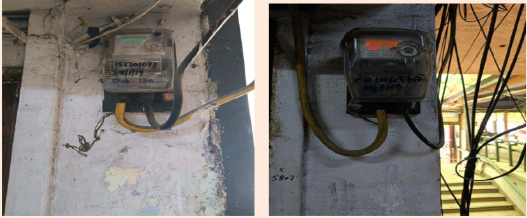
Fig.4 REG. 18 EARTHED TERMINAL ON CONSUMER’S PREMISES
7.0 Actionable Strategy: Learning from the Tragedies
To halt the daily toll of 40 fatalities, India must transition from a reactive approach to a proactive, deeply engineered culture of electrical safety.
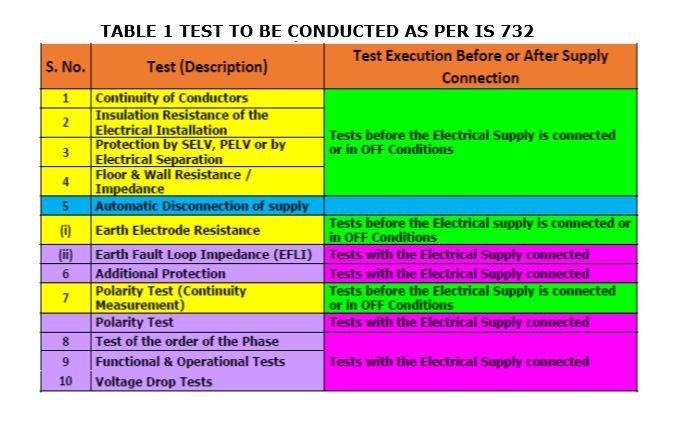
- Enforce Mandatory Third-Party Audits: Following the recent high-profile casualties, urban development authorities must enforce periodic, independent electrical safety audits for residential high-rises and commercial hubs, utilizing calibrated thermal imaging cameras to catch localized overheating (hotspots) in distribution boards before they ignite & conduct all the test as mentioned in table 1 below.
- Eradicate Substandard Components: End-users and contractors must strictly avoid non-ISI marked, counterfeit switchgear and under-sized wires. Wires must possess Flame Retardant Low Smoke (FRLS) properties to minimize toxic smoke inhalation—the primary killer in incidents like the Hauz Khas fire.
- Incorporate RCBOs at the Distribution Board: The gold standard for modern apartments is the deployment of an RCBO (IS 12640 Part 2) for critical high-power circuits like Air Conditioners. An RCBO provides dedicated short-circuit, overload, and earth-leakage protection combined in a single device, isolating only the faulty appliance without throwing the entire household into darkness.
Conclusion
The tragedies at Hauz Khas, Malviya Nagar, and across countless unnamed homes daily are preventable engineering failures. By honoring statutory compliance, mandating 30mA/300mA RCD protection, and matching load profiles precisely with Type C and Type B MCBs, we can successfully transition toward a safer grid, ensuring that our electrical infrastructure serves to empower life, not claim it. The summary of actions to be taken are given below.
- Regular Maintenance & Condition Monitoring testing of all the equipment in the system must be done periodically to avoid any hazards. The list of test to be conducted are summarized in the table 1 above.
- Proper Wiring and Installation: Ensure all wiring and electrical installations comply with building codes and standards. Avoid calling unskilled persons electrical work and hire licensed professionals for installations and repairs.
- Overload Protection: Use circuit breakers, fuses, and surge protectors to prevent overloading circuits. Distribute electrical loads evenly across circuits and avoid daisy-chaining power strips or extension cords.
- Fire Extinguishers and Smoke Alarms: Install smoke alarms in strategic locations and maintain them regularly. Additionally, equip buildings with appropriate fire extinguishers and ensure occupants are trained in their usage.
- Clearance and Ventilation: Keep electrical panels, equipment, and outlets clear of obstructions. Adequate ventilation should be maintained around electrical appliances to prevent overheating.
- Education and Awareness: Educate residents, employees, and the public about electrical safety practices, including avoiding water contact with electrical appliances, using appliances according to manufacturer instructions, and reporting any electrical issues promptly.
- Emergency Preparedness: Develop and communicate emergency procedures for dealing with electrical incidents, including evacuation plans and emergency contact information.
- Lightning Protection: All buildings and locations must be assessed for lightning strike and protection devices must be installed
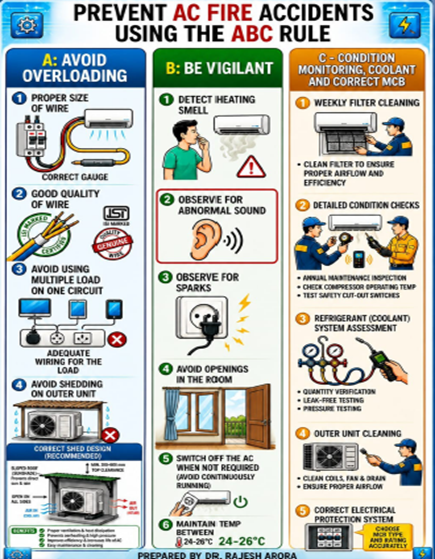
- Always obey ABC rule to prevent AC fire accidents.
By – Dr. Rajesh Kumar Arora
