

STL, a connectivity solutions provider for AI-ready digital infrastructure, today announced significant progress on its journey towards decarbonisation and its Net-Zero ambitions.
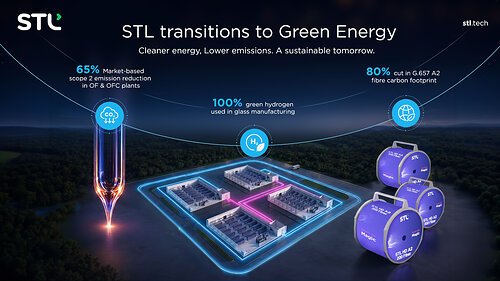
Transitioning to 100% Green Power – STL, recently, has moved a significant share of its electricity sourcing away from conventional fossil-fuel-based grid power to ‘100% Green Power’ generated from wind and solar sources. The transition covers four of the company’s four manufacturing plants in Chhatrapati Sambhaji Nagar (Aurangabad), Maharashtra. The shift has been enabled through Maharashtra State Electricity Distribution Company Limited (MSEDCL). This transition is expected to deliver a ~65% market-based scope 2 emission reduction in OF & OFC plants, representing a significant reduction in the emissions across participating plants.
100% Green Hydrogen in Glass manufacturing – STL has integrated 100% Green Hydrogen into its glass manufacturing operations, a critical, energy-intensive step in optical fibre production that has historically relied on conventionally produced hydrogen and oxygen. This has enabled STL to decarbonize one of the most difficult-to-abate stages of the optical fibre value chain.
Life Cycle Assessment – STL’s decarbonisation journey also extends to its optical products, where the company has a range of Eco-labelled Certified Optical Products.
Corporate Mobility Policy STL has updated its corporate mobility policy to accelerate the adoption of low carbon-emission vehicles. Under its Company Car Policy, STL has introduced dedicated incentives and significantly enhanced limits for employees opting for Electric and Hybrid vehicles. The company aims to systematically lower its Scope 3 operational carbon footprint and advance its broader ESG goals.
Benefits for customers Together, these initiatives mark an important step in STL’s broader sustainability strategy. This demonstrates how energy transition and technology innovation can come together to build a more sustainable digital future. A significant example of decarbonisation is STL’s G.657.A2 optical fibre, which is extensively used by its customers in Data Center and telcom networks. Its carbon footprint has been reduced from 4.7 kg CO₂e per fibre kilometre (fkm) to 0.9 kg CO₂e/fkm, representing a reduction of 80%
“Decarbonization at STL is a set of connected decisions, from the power that runs our plants to the materials that go into every kilometre of fibre we make, to the policies we make for our employees. By combining renewable energy, Green Hydrogen and Eco-labelled-led product innovation, we are making measurable progress towards building a greener and environmentally-friendly manufacturing ecosystem.” said Rahul Puri, CEO, ONB, STL.
