



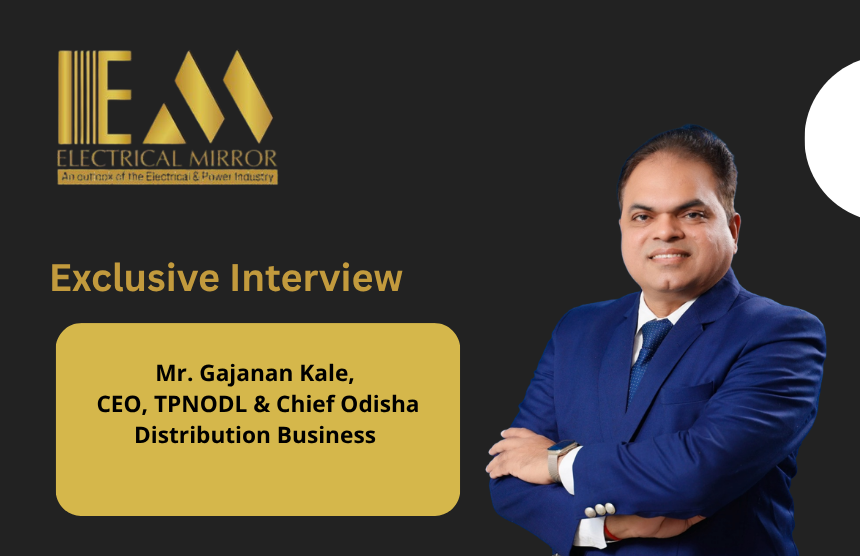
TPNODL is actively modernizing its distribution network and enhancing service delivery by transitioning from a traditional utility model to a technology-driven, digital-first entity. The vision for TPNODL and the broader Odisha landscape is rooted in a fundamental shift of moving from a traditional utility model to a digitallydriven, consumer-centric, and resilient energy ecosystem.
1.Looking ahead, what is your vision for TPNODL and the broader Odisha Distribution Business? How do you see your role in strengthening the region’s power infrastructure?
The vision for TPNODL and the broader Odisha landscape is rooted in a fundamental shift of moving from a traditional utility model to a digitally-driven, consumer-centric, and resilient energy ecosystem.
The key to strengthening the region’s power infrastructure is: Vision for a modernized Odisha power sector: The broader vision is to set a national benchmark for power distribution by focusing on three pillars.
Technological Leadership: Transitioning the grid into a “Smart Grid” by integrating SCADA and real-time monitoring.
Financial Sustainability: Improving revenue recovery in rural areas through better billing accuracy and customer engagement, as evidenced by recent national Gold Awards received at EDICON 2026 for improved Revenue Recovery in Rural Areas.
Universal Quality Power: Ensuring that even the most remote rural households in Odisha receive the same quality of power as urban centres.
Strengthening TPNODL’s Infrastructure: Our role in the northern part of Odisha is specifically focused on rapid capacity expansion and climate resilience.
Network Capacity Upgrades: To cater to load growth, constant upgrades of lines, network and transformers are carried out.
Cyclone Resilience: Given Odisha’s geography, we are investing in strengthening substations and feeders to ensure that power can be restored within 24–48 hours following major weather events.
Smart Metering: Deploying smart meters to empower consumers with real-time data on their consumption, leading to more efficient energy use and fewer billing disputes.
Human Capital & Social Impact: Infrastructure is only as strong as the people who manage it. Our strategy includes:
Skill Development Centres (HoTT): We have established five centres in northern Odisha to train thousands of employees and local ITI students in modern electrical skillsets and safety protocols.
Empowering Youth: Through the “Train to Hire” scheme, we are bridging the gap between education and employment, ensuring the next generation of Odisha’s workforce is ready for a digital grid.
Sustainable & Green Growth: We are aligning our infrastructure with the global energy transition.
Solar Integration: Facilitating rooftop solar adoption through PM Surya Ghar Muft Bijli Yojana (PMSG-MBY) & Utility-Led Aggregation (ULA) model and managing the grid to handle decentralized renewable energy.
EV Infrastructure: Expanding the EV charging network across cities by supplying power to new charging stations to support the state’s green mobility goals.
Key Metric: In the last five years, our efforts have contributed to an approximately 50% improvement in the System Average Interruption Duration Index (SAIDI) in one the Odisha DISCOMs, reflecting a significantly more stable and resilient network.
2. Over the past few years, TPNODL has made impressive progress. Could you walk us through some of the key milestones and achievements?
TPNODL has achieved significant milestones and made impressive progress over the past few years. Here’s a rundown of some key achievements:
A. Enhanced Infrastructure and Reliability:
- Increased Network Coverage: Over the past 5 years, more than 1,700 Cr Capex has been invested by TPNODL to enhance supply reliability and strengthen the network infrastructure. The company has commissioned over 1350 Ckm of new and augmented 11 kV and 33kV lines, thus improving the SAIDI and SAIFI metrics.
- Advanced Technology Adoption: The company utilizes high-precision diagnostic tools such as thermal scanners, ultrasound scanners and drone-based aerial audits for proactive network maintenance. Primary substations are now remotely operated from a centralized Power System Control Center (PSCC) using SCADA technology. Implemented Underground Power (UG) cables, Ring Main Units (RMU), Fault Passage Indicators (FPI), Auto Reclosure (AR), Aerial Tower Wagon, Cable Fault Locating Van (FLC), Telescopic Tree Pruner, etc.
- Distribution & Power Transformer Installations: Over past one year, around 270 new Distribution Transformers (DTRs) and 7 Power Transformers have been commissioned to meet increasing consumer needs.
Operational Excellence and Customer Service:
Safety Upgrades: Zero-Fatality among own & BA employees in FY26. Upgradation of hazardous substations and transformers, with fencing to prevent contact with stray animals or children
Reduction in AT&C Losses: TPNODL has significantly reduced AT&C losses from 25.17% at the time of inception to 9.95% by the end of FY26, thus becoming the first Rural Utility to reach Single Digit AT&C loss.
Billing & Collection Efficiency (BE & CE): Achieved highest BE of 90% and CE of 100% in FY26.
Improved Consumer Satisfaction: There’s been continued improvement in billing efficiency, especially in LT billing with coverage of 99.44% in LFY, and a reduction in provisional & average billing to less than 1%.
OCR – Meter Reading: 98.73% LT consumers are covered by OCR based reading.
Power Theft: Dedicated enforcement teams have been deployed to combat theft, resulting to booking of 120 MW of unauthorized load in FY. Night raids conducted to focus on removing hooking and identifying tampering.
Installation of Rooftop Solar: Around 20,000 no. of RTS installed under PMSG Muft Bijli Yojana .
Recognition in Rating: TPNODL secured an ‘A+’ rating in the 14th Integrated Rating and Ranking Report (2025) by the Ministry of Power, Government of India, ranking first in Odisha and ninth in the country among 54 power DISCOMs.
The company also received an ‘A’ rating in CSRD and ranked second nationwide in Distribution Utility Ratings.
3. Digitalization is reshaping utilities globally. How is TPNODL embracing this shift to modernize its distribution network and enhance service delivery?
TPNODL is actively modernizing its distribution network and enhancing service delivery by transitioning from a traditional utility model to a technology-driven, digital-first entity. Key initiatives include implementing smart grid technologies, enhancing real-time monitoring, and automating consumer services.
Real-time Monitoring & Control: TPNODL has implemented SCADA (Supervisory Control and Data Acquisition) systems, with 195 substations enabled for remote operation, facilitating swift outage detection and response.
Smart Grid Implementation: The company has deployed Geographic Information System (GIS) mapping, Automated Demand Management Systems (ADMS) and adopted smart meters.
Predictive Maintenance & Drone Technology: Drone technology is used for feeder maintenance, ultrasound and thermo-scanning, along with health indexing of Power Transformers (PTRs) and Distribution Transformers (DTRs), shifting from reactive to predictive maintenance.
Infrastructure Reliability: The company is installing auto-reclosers (AR) and ring main units (RMUs) for better network connectivity and fault isolation. It is also building cyclone-resilient infrastructure using Spun Concrete poles and Underground (UG) cabling for critical feeders.
Enhancing Service Delivery & Consumer Focus
Digitalized Consumer Experience: TPNODL uses digital platforms such as the “My Tata Power” App, WhatsApp bot, and missed-call services for faster complaint registration and billing services.
Digital Payments: Partnerships with various digital payment platforms have made bill payments more accessible, supported by OCR based, AI-enabled meter reading for accurate billing.
Optical Fibre Network: Usage of advanced optical fibre technology to strengthen power distribution, improve grid reliability and network infrastructure which relies on digital communication, often integrated with optical fibre for real-time monitoring and to provide better reliability and data acquisition.
Digital Month: TPNODL launched “Digital Month” in July’25 to increase awareness of digital technologies among employees and consumers, promoting digital tool usage.
Key Results:
- Reduction in AT&C losses from 25.17% (FY21) to 9.95% (FY26).
- Improved billing efficiency of 90.00%.
- Smart Meter Installation
- OCR Based Meter Reading of 98.73% LT consumers.
- ISGF Innovation Awards 2026 for Smart DT Load Management and Smart AB Switch Operation
4. Smart metering has been a major focus area. How has your experience been with its implementation, and what kind of impact have you seen on operations, efficiency, and consumer engagement?
Smart metering has been a transformative initiative, focused on modernizing the distribution network by replacing conventional meters with prepaid and post-paid smart systems to improve efficiency and transparency. In TPNODL as of FY25-26, the implementation has led to significant operational improvements, including reduction in AT&C losses of more than 15% since inception, while enhancing customer trust through accurate, real-time energy monitoring.
Impacts on Operations and Efficiency:
• Reduced Commercial Losses: The deployment of smart meters has enabled the reduction of commercial losses, supported revenue growth and increased billed units by more than 77% in last 5 years.
• Operational Efficiency: The technology allows for remote meter reading, monitoring and disconnection, eliminating manual errors and reducing the need for field staff visits.
• Improved Grid Management: Real-time data helps to identify high-demand areas and potential bottlenecks, leading to better demand response and load management.
• Rapid Fault Detection: Smart meters improve service reliability by instantly detecting outages and tampering, enabling faster restoration.
• Infrastructure Improvement: The initiative includes replacing more all faulty meters and upgrading of 11 kV feeder metering coverage.
Impact on Consumer Engagement:
Increased Transparency: Consumers have access to real-time data through digital channels, helping them to track energy usage patterns and make informed decisions to save on bills.
Reduced Billing Complaints: The automated system ensures higher billing accuracy, thus significantly reducing consumer disputes regarding billing inaccuracies.
Improved Convenience: The shift to prepaid services gives consumers better control over their monthly expenses, reducing the risk of large, unexpected bills.
Proactive Support: TPNODL has established “Anubhav Kendra” and Hands-on demonstration centres across 16 divisions to educate consumers, addressing doubts and enhancing trust in the new technology.
Digital Rebates: Offer a 4% rebate for timely digital bill payments through TPNODL apps, incentivising the transition to digital-first engagement.
Prepaid Flexibility: The rollout of prepaid smart meters allows consumers to pay only for the electricity they use, preventing “bill shocks” and providing greater control over household budgets
Energy Efficient – Home Automation (IoT Device): Smart meters provide real-time, actionable electricity data directly to the smartphone of consumers, enabling remote monitoring of voltage, current and energy consumption (kWh) to reduce power usage and costs.
Value-added services (VAS): A smart meter consumer can track consumption in real time, access prepaid functionality, adopt Time-of-Use (ToU) tariffs, integrate with smart home devices, benefit from advanced net metering for prosumers and receive personalized energy-saving suggestions for more efficient energy consumption and cost savings.
Battery Energy Storage System (BESS): Energy storage system paired with smart meter acts as Behind The-Meter (BTM) solution, enabling consumers and grid operators to optimize electricity usage, manage costs and integrate renewable energy like Rooftop Solar – PMSGMBY, etc.
Despite initial challenges, the implementation has empowered consumers to take charge of their energy consumption while transforming TPNODL’s operations from traditional manual processes to data-driven, proactive management.
5. As you scale up smart metering initiatives, what challenges do you anticipate on the ground, and how can they be effectively addressed?
Scaling up smart metering faces key ground-level challenges such as consumer resistance to prepaid systems, high non-communication rates, technical skill shortages and cybersecurity risks.
Solutions include targeted consumer education campaigns, robust data infrastructure improvements, comprehensive training for linemen and strong cybersecurity protocols.
Anticipated On-Ground Challenges & Solutions:
Consumer Resistance & Safety Concerns: Residents may resist switching from post-paid to prepaid due to fears of immediate power disconnection, resulting in protests or safety risks for field staff.
Solution: Launch intensive public awareness campaigns highlighting the benefits of prepaid metering, such as greater control over consumption and the elimination of manual meter reading, while leveraging field staff to build trust.
Non-Communicating Meters (Network Issues): High failure rates in RF (Radio Frequency) communication due to terrain or infrastructure can cause data gaps, especially in rural areas.
Solution: Strengthen network connectivity before deployment and use robust technology combinations (e.g., hybrid RF/cellular) to ensure reliable data transmission.
Workforce Transformation & Shortage: Existing meter readers fear job loss, and there is a shortage of technicians skilled in Advanced Metering Infrastructure (AMI) installation.
Solution: Reskill and retrain traditional meter readers for smart meter maintenance and digital support roles.
Technical & Data Management Bottlenecks: Integrating new meters with legacy IT billing systems can cause billing inaccuracies and delays in prepaid top-up updates.
Solution: Invest in robust, scalable Meter Data Management (MDM) systems and ensure seamless API integration between meter data and billing software.
Cybersecurity & Data Privacy: Smart metering increases vulnerability to data breaches and the hacking of smart devices.
Solution: Implement end-to-end encryption and comply with stringent data security standards.
Disaster Vulnerability – Data Centre Disaster Recovery (DCDR): Odisha’s high susceptibility to cyclones poses a constant threat to physical infrastructure and communication stability.
Solution: The Data Centre has been established in Bhubaneswar (Central Odisha), and the Disaster Recovery Centre (DR Centre) has been established at Sambalpur (Western Odisha) to protect the system infrastructure from data loss in the event of a natural calamity or disaster affecting the coastal areas.
6. Finally, from your perspective, what kind of policy support and strategic roadmap are needed to accelerate smart metering adoption across India?
To accelerate smart meter adoption in India, policy must prioritize consumer-centric engagement, mandate prepaid functionality for revenue protection and enforce robust data security standards. A strategic roadmap requires standardized, scalable technologies, enhanced private participation through Public-Private Partnerships (PPPs) and tailored communication strategies to reduce consumer resistance.
Key Policy Support & Regulatory Frameworks:
Promoting Smart Meter Adoption: Encourage the adoption of smart meters through appropriate regulatory and financial incentives while allowing flexibility in payment modes based on consumer needs and regulatory provisions.
Time-of-Use (ToU) Tariffs: Promote the adoption of ToU tariffs to encourage consumers to optimize their electricity consumption, thereby reducing peak demand and improving grid efficiency.
Consumer Protection Measures: Strengthen guidelines on advance notice, data privacy, transparent billing and prompt grievance redressal to enhance consumer confidence.
Unified Standards: Standardize communication technologies, such as NB-IoT, to ensure interoperability between meter manufacturers and DISCOM backend systems.
Strategic Roadmap for Implementation:
Public-Private Partnership (PPP) Models: Encourage greater private participation through models such as Build-Own-Operate-Transfer (BOOT) to accelerate deployment and leverage technological expertise.
Phased Deployment: Adopt a phased implementation strategy, beginning with high-loss and high-consumption areas, allowing refinements in technology and operational processes before large-scale rollout.
Consumer Awareness & Engagement: Build consumer confidence through sustained awareness campaigns highlighting the benefits of smart meters, including accurate billing, real-time consumption monitoring and improved service reliability.
Building Technical Capacity: Strengthen the technical capabilities of utility personnel through continuous training and ensure the availability of skilled manpower for installation, operations and maintenance.
Leveraging Data Analytics: Harness real-time meter data to generate actionable insights for grid planning, demand forecasting, theft detection, outage management and improved consumer services.
Smart meter adoption is not merely a technology upgrade but a transformational step towards creating a smarter, more resilient and consumer-centric power distribution ecosystem. With the right policy support, industry collaboration and consumer engagement, India can accelerate its transition to a digitally empowered electricity sector aligned with its vision of a reliable, efficient and sustainable energy future.
