



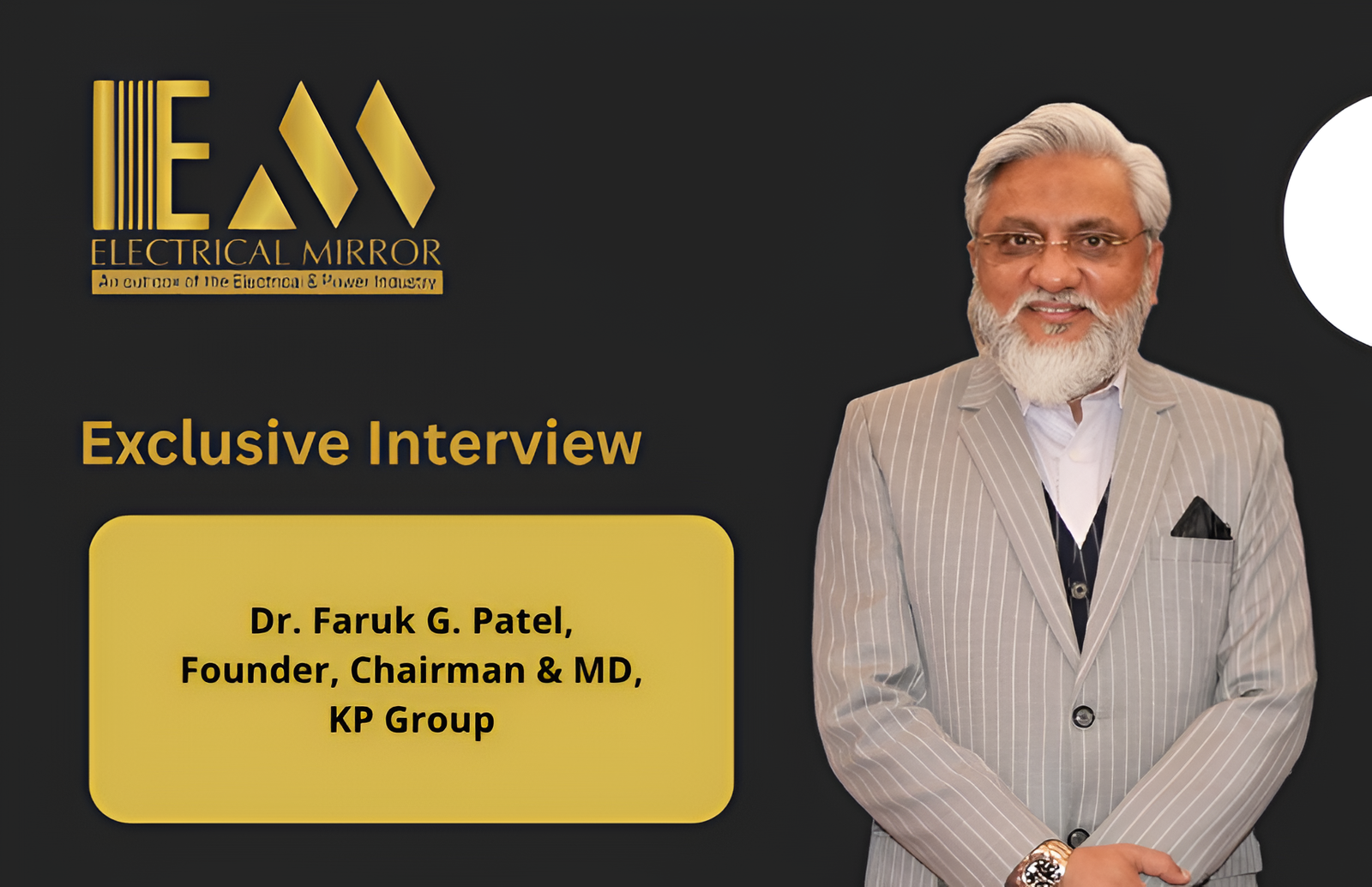
“The legacy I would like KP Group to build is one of enabling sustainable progress on a global scale. We aspire to develop infrastructure that powers industries, supports communities, strengthens energy security, and contributes meaningfully to a lower-carbon future.”
1. India’s power sector is witnessing unprecedented investments in transmission infrastructure. In this evolving landscape, what qualities will distinguish the next generation of transmission and substation structures from those that have traditionally supported the grid?
India’s power sector is entering a transformative phase where transmission infrastructure will play an equally important role as power generation itself. The next generation of transmission and substation structures will be defined by three key qualities: higher reliability, faster deployment, and greater adaptability.
As renewable energy capacity expands rapidly across the country, transmission networks must efficiently connect geographically dispersed generation sources to demand centres. This requires structures that can support higher voltage corridors, withstand increasingly diverse environmental conditions, and accommodate future grid upgrades without significant redesign.
At the same time, utilities are demanding shorter project timelines and longer asset lifecycles. Modern transmission structures must therefore combine robust engineering with optimized material usage, advanced manufacturing precision, and digital design capabilities. The future grid will not simply require stronger structures—it will require smarter infrastructure capable of supporting India’s long-term energy security and sustainability goals.
2. Transmission towers are often viewed as standard infrastructure components, yet they play a decisive role in network reliability. How is engineering innovation redefining the performance expectations of modern transmission structures?
Transmission towers may appear simple from a distance, but they are among the most critical assets in the power delivery ecosystem. Every advancement in power generation ultimately depends on the reliability of these structures to deliver electricity safely and efficiently.
Engineering innovation today is transforming transmission towers from conventional support systems into highly optimized infrastructure assets. Advanced structural analysis, computer-aided modelling, improved steel design, and precision manufacturing techniques are enabling towers to achieve greater strength while reducing overall weight and material consumption.
Innovation is also enhancing resilience. Modern structures are being designed to withstand higher wind loads, seismic activity, extreme weather conditions, and evolving grid requirements. As transmission networks become more complex, performance expectations are shifting from simply carrying conductors to ensuring long-term reliability, operational efficiency, and reduced maintenance costs throughout the asset lifecycle.
3. As utilities expand networks across challenging terrains and higher voltage corridors, what structural and design considerations are becoming increasingly critical for transmission infrastructure developers?
The expansion of transmission networks into remote and challenging geographies is creating new engineering demands for infrastructure developers. Whether crossing deserts, coastal regions, hilly terrain, or densely populated corridors, each project presents unique structural requirements.
Developers must focus on site-specific engineering, optimized foundation design, wind and seismic load considerations, corrosion resistance, and ease of installation. For higher voltage transmission lines, structural stability and conductor clearance become even more critical to ensuring long-term network reliability.
Another important consideration is constructability. Infrastructure developers must design structures that not only perform effectively but can also be transported, assembled, and commissioned efficiently in difficult locations. As transmission networks continue to grow in scale and complexity, engineering flexibility and project execution capability will become key differentiators.
4. Power evacuation has become a strategic priority for both conventional and emerging energy projects. How can the industry strengthen transmission readiness to ensure that infrastructure development keeps pace with power generation growth?
India has made remarkable progress in expanding generation capacity, particularly in renewable energy. However, the success of this transition ultimately depends on our ability to evacuate power efficiently and reliably.
Transmission planning must evolve from being a reactive process to a proactive one. Grid infrastructure should be planned in parallel with generation projects rather than after capacity additions are announced. Greater coordination between policymakers, transmission utilities, developers, and equipment manufacturers will be essential.
The industry must also invest in manufacturing capacity, supply chain resilience, advanced project management practices, and faster execution models. By strengthening these areas, we can significantly reduce bottlenecks and ensure that transmission infrastructure keeps pace with the country’s ambitious renewable energy and electrification targets.
5. KP Green Engineering’s portfolio spans transmission towers, monopoles, substations, switchyard structures, and allied products. How does this integrated capability help address the evolving requirements of utilities and EPC contractors?
Today’s infrastructure projects demand comprehensive solutions rather than isolated products. Utilities and EPC contractors increasingly seek partners who can deliver multiple structural requirements with consistent quality, reliability, and execution speed.
By offering multiple infrastructure solutions under a single roof, we help customers streamline sourcing, reduce coordination challenges, and ensure greater consistency across project execution.
At KP Green Engineering, our integrated manufacturing ecosystem enables us to serve diverse project requirements across transmission towers, monopoles, substations, switchyard structures, solar mounting structures, and other engineered steel products. This integrated capability simplifies procurement, improves coordination, and enhances project execution efficiency for our customers.
Equally important, it allows us to maintain stringent quality standards across product categories while offering the flexibility needed for customized project requirements. As infrastructure projects become larger and more complex, integrated manufacturing capabilities provide a significant advantage in delivering value, consistency, and timely execution.
6. Grid expansion today demands not only scale but also speed of execution. What technological or manufacturing advancements do you believe will have the greatest impact on transmission infrastructure deployment in the coming years?
The future of transmission infrastructure deployment will be shaped by a combination of digital engineering, automation, and advanced manufacturing technologies.
Digital design tools, Building Information Modelling (BIM), advanced simulation software, and data-driven project planning are already improving engineering accuracy and reducing project timelines. On the manufacturing side, automation, robotics, precision fabrication, and modern galvanizing technologies are enabling higher productivity while maintaining quality consistency.
Equally important is the development of large-scale, integrated manufacturing facilities capable of supporting the growing demand for transmission and substation structures. At KP Green Engineering’s Matar facility, this commitment is reinforced by Asia’s largest galvanizing kettle, enabling efficient processing of large and complex infrastructure components while ensuring superior corrosion protection and consistent quality standards.
As project sizes continue to increase, the ability to manufacture, galvanize, and dispatch infrastructure components efficiently will become a critical competitive advantage.
The companies that successfully combine engineering innovation with manufacturing excellence will be best positioned to support India’s next phase of grid expansion.
7. As the world moves toward a more electrified, decentralized, and low-carbon future, where do you see the greatest opportunity for KP Group to create lasting value, and what legacy would you like the organisation to leave behind?
The global energy transition presents one of the greatest opportunities of our time. As countries accelerate their shift toward cleaner, more resilient, and more decentralised energy systems, the demand for integrated infrastructure solutions will continue to expand.
For KP Group, this opportunity extends across the entire energy value chain—from renewable power generation and transmission infrastructure to engineering solutions, energy storage, and emerging technologies such as green hydrogen. Our ambition is not merely to participate in this transformation but to help shape and accelerate it through innovation, scale, and execution excellence.
The legacy I would like KP Group to build is one of enabling sustainable progress on a global scale. We aspire to develop infrastructure that powers industries, supports communities, strengthens energy security, and contributes meaningfully to a lower-carbon future. If future generations recognise KP Group as an organisation that helped advance the world’s transition toward sustainable energy and resilient infrastructure, that would be our greatest achievement.
