


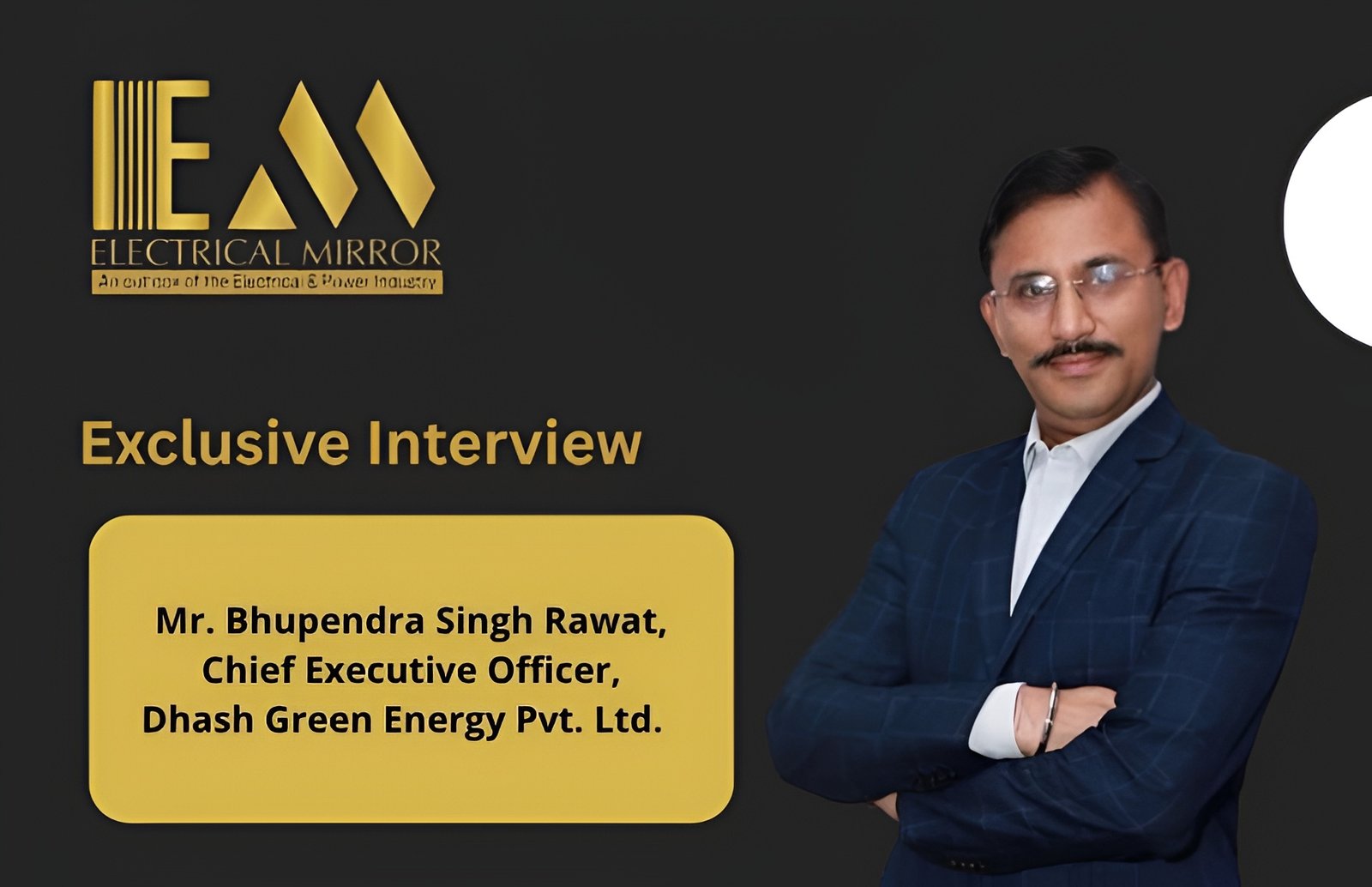
“The next chapter of Dhash will be about transforming that vision into global scale, technological leadership and long-term value creation, while demonstrating that world-class photovoltaic technologies can be engineered, manufactured and delivered from India to the world.”
1. For years, the spotlight in the photovoltaic industry has remained firmly on modules and generation capacity. However, as projects become larger and performance expectations more demanding, the conversation is gradually shifting towards the components that determine reliability over decades of operation. Has this change fundamentally altered the way companies like Dhash approach product innovation and engineering excellence?
The shift towards greater focus on component reliability has certainly transformed the photovoltaic industry, but at Dhash, this has been part of our engineering philosophy from the very beginning.
When we started our journey in 2017, the industry conversation was largely centred around module capacity and cost optimisation. However, we recognised early that the long-term performance of a solar installation depends equally on the reliability of every component within the system. A module is expected to operate for 25 to 30 years, and the junction boxes, connectors, cables and other critical components supporting it must be engineered with the same long-term perspective.
This understanding shaped our approach to product development well before component reliability became a larger industry conversation. We invested in engineering, testing, certification, automation and manufacturing capabilities with a clear objective: to develop products not only for the requirements of the present, but for the technologies and operating conditions of the future.
As modules evolved towards higher power, higher current and more demanding architectures, our focus remained on staying ahead of the technology curve. This forward-looking approach has enabled Dhash to develop solutions for emerging module technologies and evolving system requirements.
For us, engineering excellence is ultimately about anticipating change. The photovoltaic industry is evolving rapidly, and component manufacturers must be prepared for tomorrow’s requirements before they become today’s industry standards.
2. The rapid evolution of TOPCon, HJT, and other high-efficiency module technologies is placing new demands on photovoltaic components. How is this technological shift influencing the design philosophy behind next-generation junction boxes, connectors, and DC solutions?
The transition towards technologies such as TOPCon, HJT and other high-efficiency module architectures is fundamentally changing the technical requirements of photovoltaic components.
Higher module power and increasing current levels place greater demands on junction boxes, connectors and DC cables in terms of thermal performance, current-carrying capacity, electrical safety and long-term reliability. Components that were designed for previous generations of modules may not necessarily be suitable for the operating conditions of next-generation photovoltaic systems.
At Dhash, we anticipated this evolution and aligned our product development roadmap accordingly. Our engineering philosophy has focused on developing higher-current solutions, advanced thermal management, robust electrical performance and products capable of supporting emerging module architectures.
A strong example of this approach is the development of our 35A PV junction box solutions designed for high-current module technologies, along with our focus on 2000V DC connectivity solutions. These developments reflect our belief that component innovation must move ahead of market requirements rather than follow them.
Our design philosophy therefore begins with understanding where module technology is heading over the next five to ten years. We then translate those trends into engineering parameters related to current, voltage, temperature, material performance, safety and durability.
The objective is simple: when the next generation of module technology reaches commercial scale, the supporting connectivity ecosystem should already be ready.
3. Dhash has developed an integrated portfolio comprising PV junction boxes, connectors, solar cables, and complete DC solutions. How does this end-to-end approach help address the changing expectations of module manufacturers and EPC companies?
The photovoltaic industry is increasingly moving towards greater integration, standardisation and accountability across the supply chain. Module manufacturers and EPC companies are looking for partners who can provide not just individual products, but reliable, compatible and scalable solutions.
Our integrated portfolio enables us to approach photovoltaic connectivity as a complete ecosystem rather than a collection of independent components.
By bringing junction boxes, connectors, solar cables and other DC solutions under a common engineering and manufacturing platform, we can focus on compatibility, performance, quality consistency and long-term reliability across the entire DC side of the solar system.
This approach also allows us to work more closely with customers during the product development process. Different module technologies, project environments and system architectures can have different technical requirements. Having multiple product capabilities within the organisation enables us to develop customised and application-specific solutions more efficiently.
For module manufacturers, this means access to a reliable technology partner capable of supporting evolving product architectures. For EPC companies and project developers, it means greater confidence in product compatibility, supply reliability and system performance.
Ultimately, our ambition is to evolve from being a component manufacturer into a comprehensive technology and solutions partner for the global photovoltaic industry.
4. India’s ambition to become a global manufacturing hub for clean energy technologies extends beyond solar modules alone. Where do you see the greatest opportunity for Indian component manufacturers to create long-term value within the global photovoltaic supply chain?
India has a significant opportunity to build a globally competitive photovoltaic manufacturing ecosystem, but achieving true manufacturing leadership requires us to look beyond module capacity alone.
A strong solar manufacturing industry depends on an equally strong ecosystem of components, materials, technologies, manufacturing equipment and engineering capabilities. Junction boxes, connectors, solar cables, interconnect ribbons, encapsulants, frames and several other critical components represent enormous opportunities for Indian manufacturers.
The greatest long-term opportunity lies in moving from import substitution to technology leadership.
India should not aspire merely to manufacture products that were previously imported. We must develop the engineering capabilities, intellectual property, manufacturing technologies and product innovations that allow Indian companies to compete globally.
At Dhash, this philosophy has guided our journey from the beginning. Our focus has been on developing domestic manufacturing capabilities for critical photovoltaic components while continuously investing in technology, automation, quality and product development.
The global solar industry is looking for resilient, diversified and reliable supply chains. India has the scale, engineering talent, manufacturing capability and market opportunity to become one of the world’s most important clean energy manufacturing hubs.
The next decade will be about creating globally competitive Indian companies that can design, manufacture and supply advanced photovoltaic technologies to markets across the world. That is where we see the greatest opportunity for long-term value creation.
5. Every phase of industrial growth demands a different kind of leadership from building capabilities to defining industry benchmarks. As Dhash enters its next stage of evolution, what strategic priorities will shape the company’s growth narrative over the coming years?
The first phase of our journey was about building capabilities, developing products and establishing a strong manufacturing foundation. The next phase is about scale, technology leadership, global expansion and creating a more integrated photovoltaic manufacturing ecosystem.
Our strategic priorities will be driven by several key areas.
First, we will continue investing in product innovation and engineering capabilities to remain ahead of emerging photovoltaic technologies. As module architectures evolve, the supporting component ecosystem must evolve equally rapidly.
Second, we are expanding our capabilities across critical areas of the photovoltaic value chain. Our objective is to create an increasingly integrated portfolio of advanced solar components and DC solutions that can serve customers in India and international markets.
Third, manufacturing excellence and automation will remain central to our growth strategy. Scale alone is not sufficient. Global competitiveness requires consistency, efficiency, quality and the ability to deliver reliable products at large volumes.
Another important priority is international expansion. As global supply chains become more diversified, we see significant opportunities to strengthen Dhash’s presence across key international solar markets.
Above all, our focus will remain on building an organisation that is prepared for the future of the industry. Growth for us is not simply about increasing manufacturing capacity. It is about building technology, capabilities and institutions that can contribute meaningfully to India’s emergence as a global clean energy manufacturing leader.
6. Dhash has established itself as a key player in photovoltaic connectivity solutions. As the company looks toward its next chapter, what ambitions will shape its future roadmap, and how do you envision expanding its role within both the Indian and global solar value chain?
Our ambition is to build Dhash into a globally recognised solar technology and manufacturing company with capabilities extending across critical areas of the photovoltaic value chain.
The journey that began with PV junction boxes has progressively expanded into connectors, solar cables, PV interconnect ribbons and busbars, and integrated DC solutions. Each expansion has been driven by a clear understanding of where the industry is heading and what capabilities will be required in the future.
As we move into our next chapter, our roadmap will focus on three fundamental areas: technology leadership, integrated manufacturing and global presence.
We will continue investing in advanced product development to address emerging module technologies, higher-current architectures and next-generation photovoltaic systems. At the same time, we intend to strengthen our manufacturing capabilities across critical solar components, creating a more integrated and resilient supply ecosystem.
Global expansion will also play an important role in our future strategy. India is increasingly being recognised as a reliable manufacturing and technology partner, and we believe Indian companies have a significant opportunity to serve global markets with world-class products and solutions.
Our larger vision, however, extends beyond business growth. We want Dhash to contribute to building India’s technological and manufacturing independence in critical sectors.
We began our journey with a fundamental question: why should a nation with the ambition to lead the world remain dependent on others for its critical components?
That question continues to define our direction.
The next chapter of Dhash will be about transforming that vision into global scale, technological leadership and long-term value creation, while demonstrating that world-class photovoltaic technologies can be engineered, manufactured and delivered from India to the world.
