



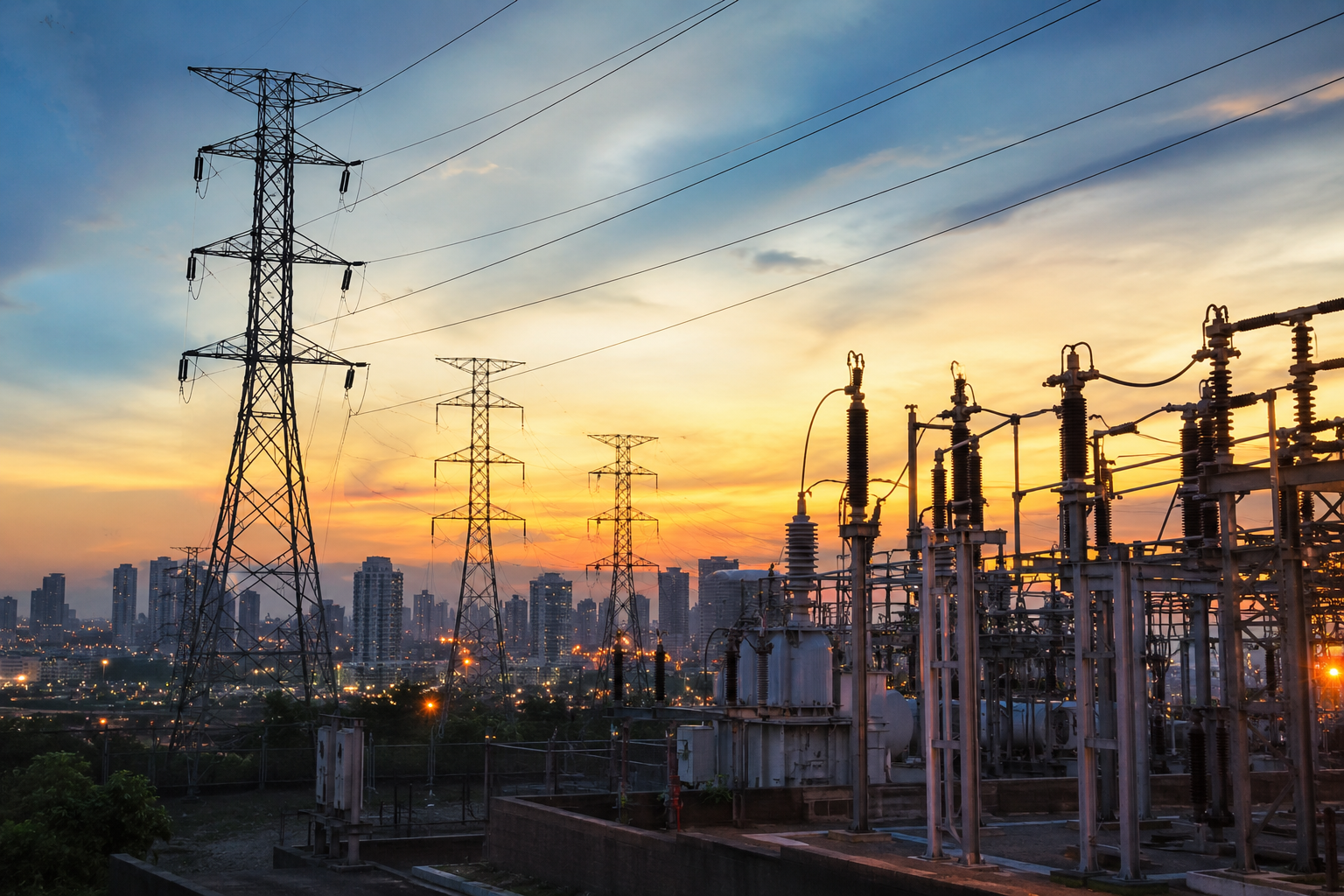
Tata Power has unveiled a 400 kV ring network within Mumbai to strengthen grid reliability and ensure uninterrupted power supply amid the city’s rapidly growing electricity demand, driven by the expansion of Metro corridors, data centres, and large-scale infrastructure projects.
According to company officials, Mumbai’s peak power demand is projected to increase by nearly 40% over the next five years, rising from 4,642 MW in 2026 to approximately 6,500 MW by 2031. To support this growth, Tata Power plans to invest around ₹15,000 crore over the next five years in expanding and modernising its transmission infrastructure.
A key component of the upgrade programme is the strengthening of transmission corridors outside Mumbai. The critical Kalva-Kalyan transmission line is expected to be completed by the end of the current financial year. Once operational, the line will significantly enhance power inflow into Mumbai, increasing the system’s wheeling capacity to around 1,300 MW from the current 150 MW—an eightfold increase.
“The 400 kV ring network inside Mumbai will be a gamechanger. It will connect Vikhroli, Dharavi, Mahalaxmi, Sewree and Trombay, along with a 765 kV link to Dolvi and will facilitate the import of significantly higher volumes of power into Mumbai,” said Nilesh Kane, Chief – Transmission and Mumbai Distribution, Tata Power.
Kane added that the Vikhroli-Dharavi section of the project is nearing completion and is expected to provide reliable power supply to areas associated with the Dharavi Redevelopment Project.
The proposed ring network has been designed to improve redundancy, minimise outages, and provide greater operational flexibility in managing load across different parts of the city.
In parallel, Tata Power is undertaking the upgrade of 10 existing 110 kV transmission line corridors to 220 kV over the next five years. These include the Dharavi-Mahalaxmi, Mahalaxmi-Backbay, Carnac-Backbay, Bhokarpada-Karanjade, Khopoli-Bhokarpada, Khopoli-Bhivpuri, Bhivpuri-Ambernath, Ambernath-Kalyan, and Kalyan-Kalwa corridors. The upgrades will enable significantly higher power transfer capacity through existing rights-of-way, eliminating the need for additional land acquisition.
“Also, eight existing 110 kV stations at Bhivpuri, Khopoli, Powai, Parel, Kalyan, Ambernath, Vikhroli and Kolshet are being upgraded to 220 kV level, with the Kolshet station also being interconnected with MSETCL,” Kane said.
On the energy storage front, Tata Power has already commissioned two Battery Energy Storage Systems (BESS) of 20 MW each and plans to scale up the capacity to 200 MW with an investment of approximately ₹300 crore. Additionally, the company operates 150 MW of pumped hydro storage capacity.
The storage infrastructure will enable surplus electricity generated during daytime hours to be stored and supplied during non-solar periods, helping bridge demand-supply gaps while enhancing overall grid stability.
The transmission and storage expansion initiatives are aimed at supporting Mumbai’s long-term energy requirements as the city witnesses rapid urbanisation, data centre development, Metro rail expansion, and major redevelopment projects across the Mumbai Metropolitan Region.
