



Nuclear power moved to the centre of discussions on the second day of the 20th Indian Chamber of Commerce (ICC) India Energy Summit, themed “The Energy Business: The Present, Diversification and the Future,” in New Delhi. A focused panel discussion on nuclear power and Bharat Small Reactors (BSRs) examined the opportunities and challenges associated with scaling up nuclear energy in India.
India is looking to expand nuclear capacity from about 8.8 GW towards 100 GW, and the discussion stressed turning this vision into a practical framework covering land acquisition, community engagement, water management, component manufacturing and skilled manpower.
A central theme was the BSR programme, which builds on India’s established 220 MW pressurised heavy water reactor technology to meet industry’s captive power needs, offering energy-intensive sectors round-the-clock, low-carbon electricity, subject to the applicable regulatory framework.
Highlighting the evolution of India’s nuclear reactor programme, Kishor U Agarwal, Director (Nuclear Strategy & Advisor), Vedanta Power, emphasised that the country’s experience with 220 MW reactors provides a strong engineering foundation for the BSR initiative.
Agarwal, who spent 36 years at the Nuclear Power Corporation of India Limited (NPCIL) before moving to Vedanta Power, explained that the Government sought a way to bring private industry into nuclear power for its captive needs, which he put at about 65 to 70 gigawatts. The answer was NPCIL’s proven 220 MW reactor, which private partners can build jointly with NPCIL while NPCIL operates the plant.
“The 220 MW reactor is a proven technology, with the last unit built by NPCIL commencing commercial operations in 2012. Since then, these reactors have demonstrated reliable performance, with all units continuing to operate and deliver power. The Bharat Small Reactor programme therefore builds on decades of operating experience, while standardisation has helped resolve several engineering challenges. The priority now is to strengthen the domestic supply chain and equip Indian industry to support wider deployment,” he said.
He noted that one Kaiga reactor has operated for over 1,000 days and that a single truckload of fuel can sustain a reactor for about a year. On standardisation, he said, “The engineering has been done so well that anybody who comes can go straight to ordering equipment. Whether it is a nuclear system or a secondary system, it is now standardised.” Only two niche components, currently imported, are not yet made in India, and we expects Indian suppliers to start making them within a year or two. NPCIL is also setting up an engineering division for private industry within months.”
Prasenjit Pal, Senior Advisor – Nuclear at Bajaj Energy and former Executive Director (Nuclear) at NTPC Parmanu Urja Nigam Ltd. drew on his experience at the Mahi Banswara project in Rajasthan. “Siting a nuclear power project is totally a different cup of tea,” he said. A site must be geotechnically sound, have a major water source, and sit away from seismic faults and military or industrial establishments, which sharply narrows the options. A twin 700 MW project, he noted, needs about 15 lakh cubic metres of concrete and 80 million cubic metres of water a year.
On regulation, “In nuclear, the regulator is involved right from the siting stage. At every stage the regulator is involved,” he said, listing the Atomic Energy Regulatory Board’s site acceptance, siting, excavation and first pour of concrete clearances.
Pal said community trust matters as much as engineering. At Mahi Banswara, where investment of about ₹48,000 crore is planned, new schools, roads and solar streetlights gave villages visible proof of the project’s benefits. “The local population has to be with you to enable you to establish a project,” he said. Excavation is about 50 days ahead of schedule, clearance for the first pour of concrete is expected around the middle of next year, and the first unit is targeted for criticality in 2032. “It is a long haul, but we seem to have made a good start.”
On equipment, Pal noted that “Once the steam is outside the reactor, it is just like any other steam-based power plant,” urging that existing thermal power vendors participate in the non-nuclear island, and called for more agencies able to turn special alloys into reactor components guaranteed for the plant’s lifetime.
The SHANTI Act, assented to on 20 December 2025, now allows private participation in plant operations, power generation and equipment manufacturing. Challenges remain, including high capital costs, long build times, scarce sites, imported alloys and clarity on tariffs and fuel supply. Over the next five years, the focus shifts from policy to projects: reactors under construction are due by 2031-32, and the government aims for at least five indigenous small modular reactors by 2033, towards 100 GW by 2047.
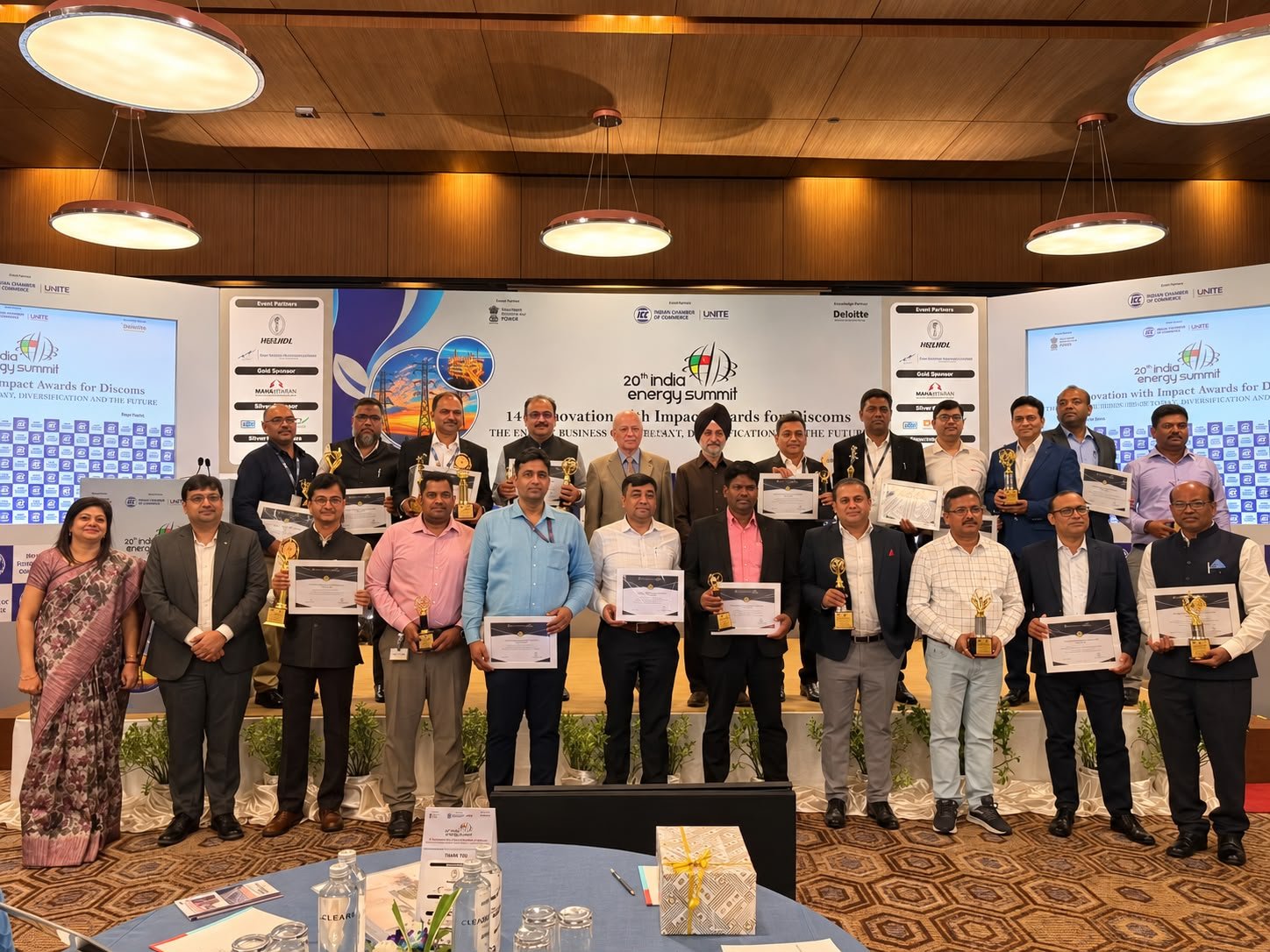
The day concluded with the ICC Awards, including the Best State Power Utility Awards and the 14th Innovation with Impact Awards for Discoms 2026, recognising consistently performing public- and private-sector power distribution companies from across India. The awardees included Maharashtra State Electricity Distribution Company Limited, Kerala State Electricity Board, BSES Yamuna Power Limited, Northern Power Distribution Company of Telangana Limited, Tata Steel Utilities and Infrastructure Services Limited. The West Bengal State Electricity Distribution Company Limited received a Special Jury Award for Quality and Distribution of Power Supply During Criticalities.
The summit was organised by the Indian Chamber of Commerce, with Deloitte serving as Knowledge Partner and Award Evaluator.
