


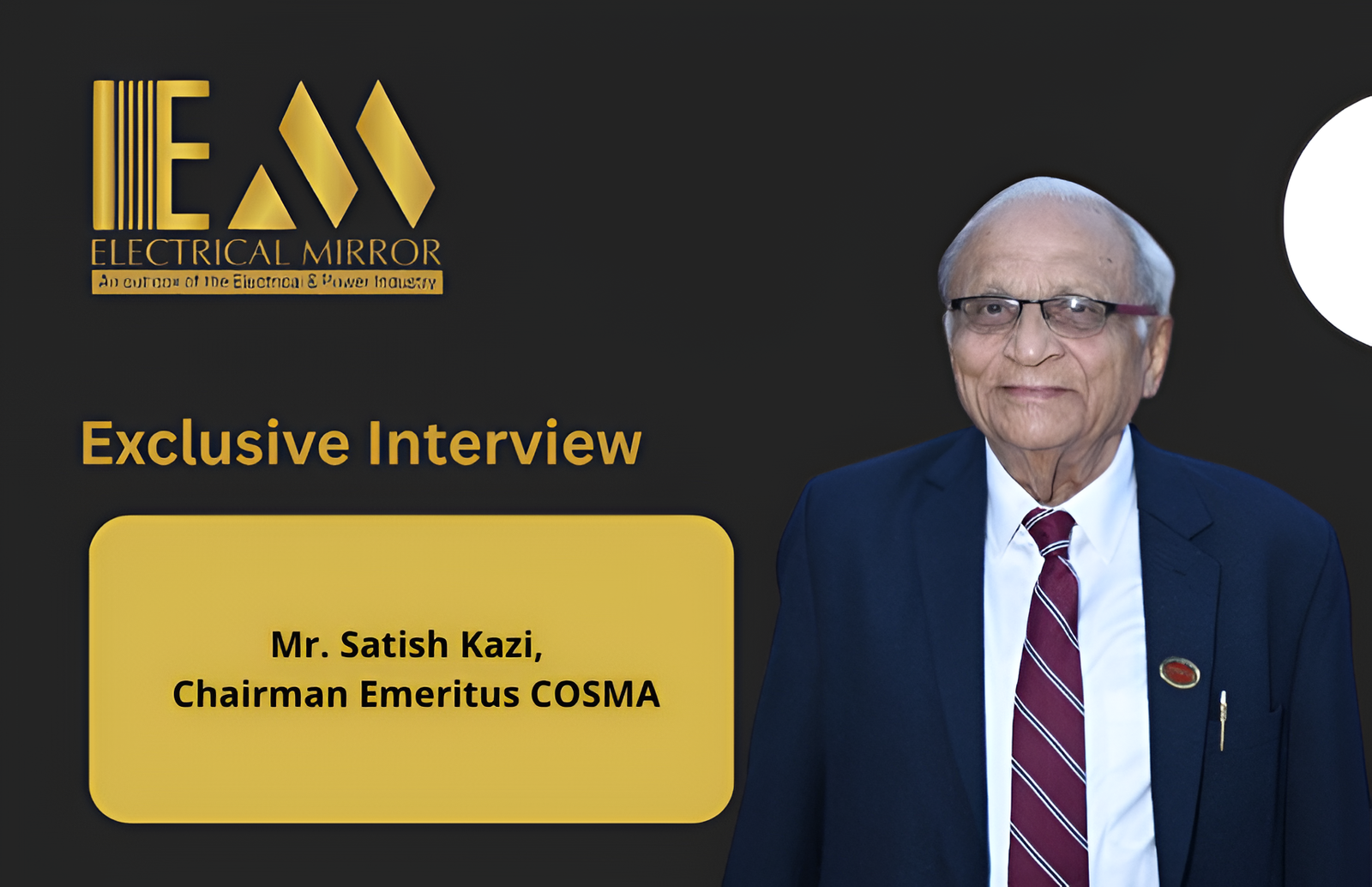
One of COSMA’s defining principles is “No Confrontation.” Whether dealing with government, multinational companies or industry associations, we have always believed that meaningful progress comes through dialogue rather than conflict. At COSMA, we have always maintained a balanced and inclusive approach. We do not believe in drawing distinctions between multinational and Indian manufacturers.
Your journey has closely mirrored the evolution of India’s electrical industry. Looking back, how did your professional journey begin, and what defining moments shaped your career?
My journey in the electrical industry began over six decades ago. After completing my higher secondary education, I moved to Mumbai and spent a year at Ruia College before pursuing Electrical Engineering at VJTI. Graduating in 1959 as the Gold Medallist and securing the first rank in my class gave me the confidence to build a career founded on technical excellence and perseverance.
After working briefly with two small organisations, I joined Larsen & Toubro in 1960, when its electrical business was still in its formative years. Beginning as a Junior Engineer, I gradually took on greater responsibilities and eventually led sales for the company’s Western Region, covering Maharashtra, Gujarat, Madhya Pradesh and Goa. During my tenure, our regional business grew from nearly ₹32 lakh to approximately ₹5 crore.
One of the defining milestones of my career was the successful market development of the MK-1 Starter. While the product was based on Danish technology, its true strength lay in its reliability and suitability for Indian agriculture. Rather than relying on conventional sales methods, we introduced an innovative rural outreach programme that connected directly with farming communities through village campaigns and film screenings. The objective was to build trust before promoting the product.
The response was remarkable. Farmers began identifying the product simply as “LTLK,” and within four years we captured nearly 85 per cent of the market. We later introduced integrated irrigation panels and successfully promoted air circuit breakers at a time when the industry was transitioning from conventional oil-based systems. These experiences reinforced my belief that technology succeeds only when it addresses real customer needs.
In 1974-75, after fifteen rewarding years at Larsen & Toubro, I embarked on an entrepreneurial journey by establishing my own manufacturing ventures. For the next three decades, I remained closely associated with India’s electrical manufacturing sector, contributing not only as an entrepreneur but also as an industry mentor and institution builder.
What inspired you to establish COSMA, and how has the association evolved over the years?
COSMA was founded on a simple yet powerful belief that competition should encourage excellence, not create hostility. During the rapid expansion of India’s sugar industry in the 1980s, I observed that manufacturers were becoming competitors in the marketplace but adversaries outside it. I believed there had to be a better approach.
Together with three close friends, I established the Control Panel and Switchgear Manufacturers Association (COSMA) in 1988. Our philosophy was centred on the idea of “Friendly Competitors”, professionals who compete ethically while working collectively for the advancement of the industry.
The association was built on four enduring principles: brotherhood, mutual support, long-term professional relationships and collaborative growth. Inspired by the values of Rotary International, we wanted to create a platform that encouraged knowledge sharing rather than rivalry.
What began with just four founders has today grown into a nationwide association with more than 560 members. Through our close association with ELECRAMA, IEEMA and leading industry exhibitions, COSMA has evolved into a respected platform that promotes collaboration, technical excellence and the overall development of India’s electrical manufacturing ecosystem.
Beyond industry development, COSMA is also recognised for its social initiatives. Could you tell us about your efforts in this area?
Social responsibility has always been an integral part of my journey. Although I graduated from VJTI in 1959, my association with the institute has remained unbroken. I had the privilege of serving as the first Chairman of the VJTI Alumni Association, and today the alumni network has grown to over 3,200 members.
One initiative that is particularly close to my heart is Vyjayanti, the annual alumni magazine that I have edited since its inception. The publication celebrates institutional achievements, showcases alumni contributions and supports scholarship initiatives for deserving students.
In 2010, we established the Hari Om Charitable Trust with the objective of supporting underprivileged schoolchildren. What began with a single school and 110 students has expanded to nearly 65 schools, benefiting around 3,000 children annually.
During the 2024-25 academic year, the Trust distributed educational materials worth approximately ₹1.14 crore. In 2025-26, that figure increased to nearly ₹1.20 crore, and we are determined to surpass it once again. These initiatives are possible because of the collective support of many individuals who share the same vision of giving back to society.
For me, contributing to society has always been as important as contributing to industry. True success lies not only in professional achievements but also in creating opportunities that positively impact future generations.
With your extensive experience, what technologies and trends do you believe will define the future of the electrical industry?
The switchgear industry today continues to be dominated by global leaders such as ABB, Siemens and Schneider Electric. Their sustained investments in research, product development and technological innovation have significantly influenced the evolution of the electrical sector. Larsen & Toubro also built a strong switchgear business over the years before it became part of Schneider Electric, while C&S Electric was subsequently acquired by Siemens. These developments reflect the growing consolidation and technological advancement within the industry.
At the same time, it is encouraging to see Indian manufacturers such as Havells, HPL and several other emerging companies steadily strengthening their market presence. Although they may not yet match the global scale of multinational corporations, they are making significant progress by enhancing their manufacturing capabilities, investing in technology and expanding their product portfolios.
At COSMA, we have always maintained a balanced and inclusive approach. We do not believe in drawing distinctions between multinational and Indian manufacturers. Global companies have contributed immensely to the industry through advanced technologies, robust R&D and international best practices, and their role deserves recognition. Equally, we believe it is our responsibility to encourage and support Indian manufacturers as they continue to build globally competitive businesses under the vision of Make in India.
In fact, whenever Indian companies seek guidance on expanding their market presence or strengthening their position, I am always willing to share my experience. My objective has always been to contribute to the growth of Indian industry because a stronger domestic manufacturing ecosystem ultimately strengthens the nation.
India possesses tremendous manufacturing potential. With continued investments in innovation, quality, customer confidence and indigenous product development, I am confident that Indian companies will not only strengthen their position in the domestic market but also emerge as globally respected players, contributing meaningfully to the country’s vision of self-reliance in electrical manufacturing.
How do you view the Make in India initiative, and what more can be done to strengthen the industry’s growth?
One of COSMA’s defining principles is “No Confrontation.” Whether dealing with government, multinational companies or industry associations, we have always believed that meaningful progress comes through dialogue rather than conflict.
I recall an instance when some of our members faced technical challenges with a product developed by my former organisation, Larsen & Toubro. Instead of publicly criticising the company, we chose constructive engagement. We met the product development team, discussed the issues professionally and, within a month, the product was modified to address our concerns.
That experience reinforced an important lesson that solutions emerge from collaboration, not confrontation. This philosophy has enabled COSMA to build lasting relationships across the industry with manufacturers, associations, exhibition organisers and government bodies alike. Our objective has always been to unite the industry around a common purpose of advancing India’s electrical manufacturing capabilities while fostering a culture of cooperation, innovation and shared progress.
