


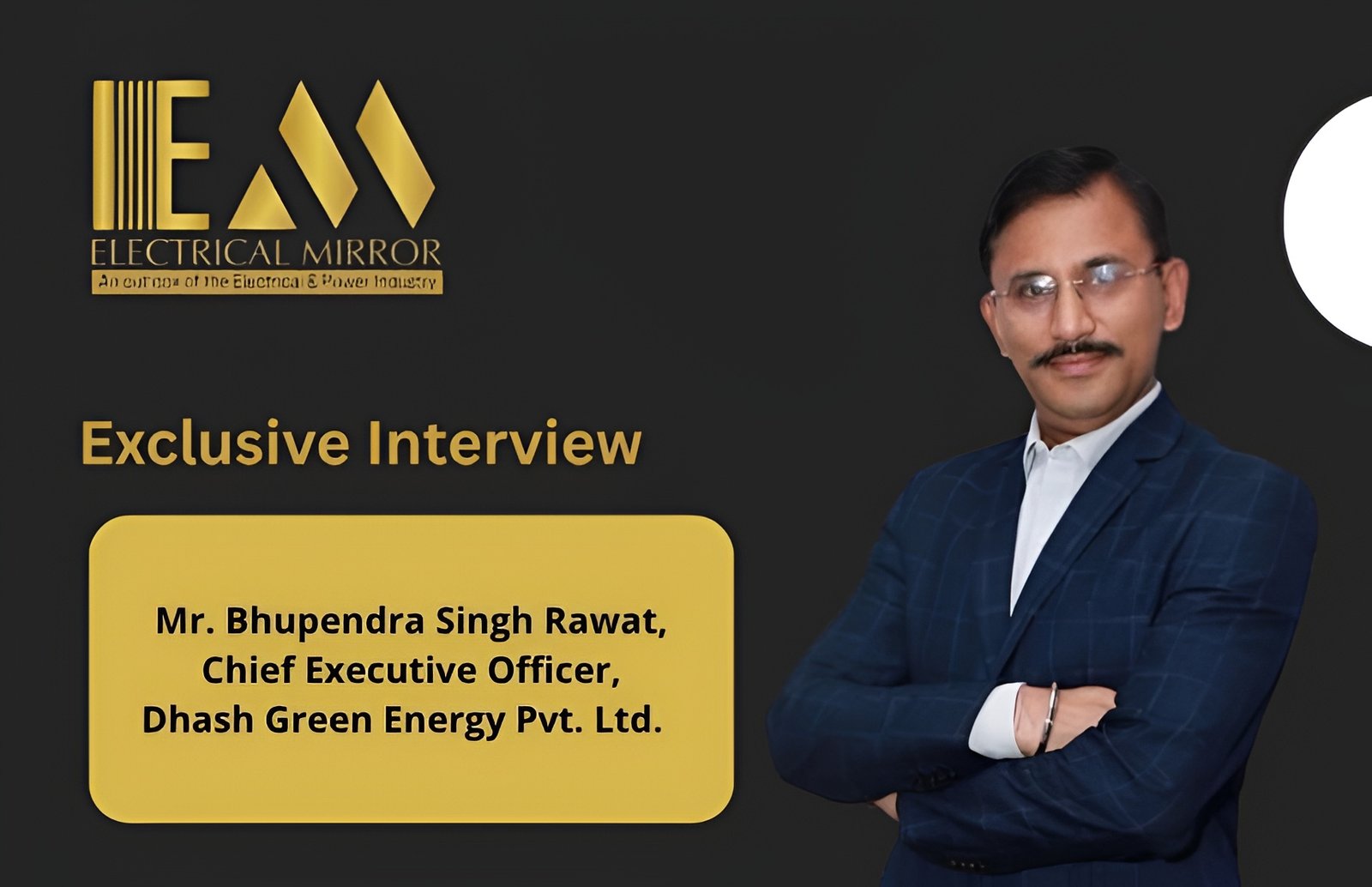
“Our long-term vision is to contribute to an Indian PV ecosystem in which critical components are not simply assembled domestically, but are engineered, manufactured and continuously innovated in India for global markets. That is the transition we believe matters most moving India from being a major solar market to becoming a major solar technology and manufacturing base.”
1. India is rapidly transitioning from module assembly towards a more integrated solar manufacturing ecosystem. What role will locally manufactured PV components play in making Indian solar products globally competitive?
The next stage of India’s solar manufacturing journey has to go beyond module assembly. A globally competitive solar industry requires a complete ecosystem covering cells, modules and the critical components that determine module performance, reliability and lifecycle economics.
Locally manufactured PV components have a very important role in this transition. Junction boxes, connectors, ribbons, busbars, cables, frames and other bill-of-material components may represent a smaller proportion of the overall module value compared with cells, but their quality directly affects electrical performance, mechanical integrity and long-term reliability.
India has already made significant progress in expanding module and cell manufacturing. The government’s PLI programme specifically aims to develop an ecosystem for high-efficiency PV manufacturing and local material sourcing, while the ALMM framework has progressively expanded to cover modules and cells.
The next challenge is therefore depth of localization or backward integration.
For India to compete globally, domestic component manufacturers need to offer three things simultaneously: international-quality products, competitive manufacturing economics and dependable supply at scale.
At Dhash PV, this is central to our strategy. We are building capabilities across junction boxes, connectors, solar cables, PV ribbon and busbar solutions and composite frames so that Indian module manufacturers have access to a broader domestic component ecosystem.
Localization or backward integration also reduces supply-chain exposure. Shorter lead times, local technical support, better coordination with module manufacturers and greater control over quality and engineering changes can all improve manufacturing competitiveness.
Ultimately, India’s objective should not be to replace imported components simply because they are imported. The objective should be to manufacture components in India that are good enough to compete globally on technology, quality, reliability and cost.
That is the standard we believe Indian component manufacturers should work towards.
2. Solar modules are becoming larger, more powerful and increasingly sophisticated. How will these technology shifts influence the design and performance requirements of critical components such as junction boxes, connectors, ribbons, busbars and frames?
The increase in module size and power is changing the requirements of virtually every component within a PV module.
As module current and voltage characteristics evolve, the junction box and connector system must be capable of handling higher electrical loads while maintaining low resistance, thermal stability and reliable contact over long operating periods.
For junction boxes, this means greater attention to current ratings, voltage ratings, thermal management, bypass-diode performance, insulation and sealing. Our TRIO Pro 35A platform, for example, has been developed around the requirements of higher-current, high-power module architectures, with applications including TOPCon and HJT.
Connectors similarly must maintain reliable electrical and mechanical contact under outdoor conditions while meeting the relevant safety and certification requirements with high current carrying capability (up to 55A with 6sq.mm cables) and suitability under higher system voltage applications (up to 2000V DC)
The interconnection system is also evolving. Higher-efficiency cells and larger modules place greater emphasis on the dimensional accuracy, conductivity, mechanical behaviour and soldering characteristics of ribbons and busbars.
Frames face another set of challenges. Larger modules mean greater mechanical loads, transportation challenges and installation considerations. At the same time, developers increasingly operate in coastal, high-humidity and other aggressive environments. This is creating interest in materials and designs that combine structural performance with corrosion resistance and weight optimisation.
Therefore, the component industry cannot simply make existing products larger. The architecture of the component itself has to evolve with the module.
At Dhash, we see this as an integrated engineering challenge. Our objective is to ensure that junction boxes, connectors, interconnection products, cables and frames evolve in parallel with module technology.
3. With TOPCon, HJT and other high-efficiency technologies gaining momentum, how is the evolution of cell and module technology changing the component manufacturing landscape?
The shift towards high-efficiency cell technologies is changing the component landscape in a fundamental way.
TOPCon has rapidly become a major technology platform in India’s manufacturing ecosystem. Industry data indicates that approximately 70% of installed Indian module manufacturing capacity was based on TOPCon technology by the end of 2025, while HJT capacity was also beginning to emerge.
For component manufacturers, this means the traditional approach of developing a standard component and supplying it across module platforms is becoming less effective.
Different cell architectures can create different requirements around current handling, interconnection, thermal behaviour, soldering, mechanical stress and module construction.
For example, as cell efficiencies increase and module power rises, junction boxes and connectors need to accommodate higher electrical performance without compromising thermal and insulation characteristics.
Similarly, ribbon and busbar technologies have to evolve with cell interconnection architectures. The focus is increasingly on electrical conductivity with optimum/minimal cell to module losses, dimensional precision, surface characteristics, mechanical flexibility and compatibility with automated module manufacturing processes.
Material science becomes equally important. Components installed in a PV module are expected to remain functional for decades while being exposed to thermal cycling, humidity, UV radiation and mechanical stresses.
This is why Dhash is investing in product development across multiple component categories rather than treating each product as an isolated business.
The future component manufacturer will need to understand the cell-to-module technology chain, not simply manufacture individual parts.
4. India is looking to increase its presence in global solar supply chains. What are the biggest gaps that need to be addressed in terms of component technology, quality standards, manufacturing scale and supply-chain reliability before India can become a major global PV component hub?
India has made substantial progress, but the next challenge is building depth and competitiveness across the entire value chain.
The first gap is technology. India needs greater domestic capability in advanced materials, process engineering, precision manufacturing and product development. Manufacturing capacity without technological depth can create volume, but it does not necessarily create global competitiveness.
The second is quality consistency. Global customers expect components to perform consistently across millions of units and across different climatic environments. Certification is important, but equally important are manufacturing controls, traceability, process capability and long-term reliability validation.
The third is scale economics. Indian manufacturers need to achieve production volumes and automation levels that allow them to compete with established global supply chains not only on quality but also on cost.
The fourth is the upstream supply chain. Components cannot become genuinely localised if their critical raw materials and intermediate inputs remain heavily dependent on uncertain external supply. India’s manufacturing ecosystem therefore needs stronger capabilities in materials, specialised metals, polymers, chemicals and other inputs.
Finally, there is the question of delivery reliability.
A module factory operating at gigawatt scale cannot afford unpredictable component availability. A component supplier therefore needs robust procurement, inventory planning, quality assurance, manufacturing redundancy and logistics systems.
Industry discussions in India have increasingly highlighted this need to deepen domestic manufacturing across balance-of-system and bill-of-material components.
For Dhash, this means building not only factories but an integrated manufacturing capability where engineering, materials, production, quality and supply chain operate as one system.
That is what will allow Indian component companies to move from being domestic suppliers to becoming global suppliers.
5. Reliability over a 25–30-year operating life is becoming increasingly important for developers and financiers. How can component manufacturers contribute to improving the long-term bankability and performance of Indian-made solar modules?
Bankability ultimately comes down to confidence.
When a developer or financier evaluates a solar project, the question is not simply whether a module performs well when it leaves the factory. The question is whether the module and its components will continue to perform predictably over decades of operation.
Component manufacturers have an important role in establishing that confidence.
The first requirement is material selection and qualification. Materials must be evaluated for UV exposure, humidity, thermal cycling, mechanical stress, corrosion and other environmental conditions relevant to the intended application.
The second is product validation. Electrical, mechanical, thermal and environmental testing needs to be integrated into product development rather than treated as a final inspection exercise.
The third is manufacturing consistency. A well-designed product is only as reliable as the manufacturing process that produces it. Automation, process controls, traceability and statistical quality monitoring become increasingly important at high volumes.
The fourth is field feedback.
Manufacturers should continuously analyse field performance, warranty data, failure modes and customer feedback and use that information to improve product design and manufacturing processes.
At Dhash, we view reliability as a combination of design reliability, material reliability and manufacturing reliability.
Our objective is to build components that do not simply meet a specification on day one but are engineered for the environmental and electrical stresses they will encounter throughout their operating life.
This is particularly important for components such as junction boxes, connectors and interconnection systems, because a relatively small component failure can affect the performance of an entire module.
MNRE itself highlights the importance of reliability because solar installations are generally designed around approximately 25-30 years’ operating periods and long-term warranties.
For the Indian industry, improving component reliability is therefore not just a quality objective. It is part of building the bankability and international credibility of Indian-made PV products.
6. Looking towards 2030, what is Dhash Green’s vision for its role in India’s solar manufacturing ecosystem, and which technologies or product categories do you believe will drive the company’s next phase of growth?
By 2030, our ambition is for Dhash to be recognised as a technology-driven Indian solar component company with a meaningful global footprint.
We see the opportunity across several interconnected product categories.
The first is advanced junction boxes and connectors, particularly solutions designed for higher-current, higher-voltage and next-generation module architectures.
The second is PV ribbon and busbar technology. As cell architectures continue to evolve, interconnection technologies will become increasingly important to module efficiency, reliability and manufacturing productivity.
The third is solar cables and electrical interconnection products, where long-term outdoor durability, electrical performance and material technology will remain critical.
The fourth is advanced module-frame technology, including composite materials that can address corrosion, weight and structural requirements for specific applications.
Beyond individual products, our larger focus will be on advanced materials, automation and manufacturing intelligence.
India’s solar manufacturing opportunity is becoming increasingly large. Industry data indicates that India’s module manufacturing capacity expanded rapidly through 2025, while TOPCon became the dominant technology platform.
The opportunity for companies like Dhash is to grow alongside this transformation while anticipating what comes next.
We therefore see our 2030 journey in three stages:
Build scale. Build technology. Build global trust.
Scale gives us manufacturing strength. Technology gives us differentiation. Global trust comes from consistently delivering products that perform reliably over decades.
Our long-term vision is to contribute to an Indian PV ecosystem in which critical components are not simply assembled domestically, but are engineered, manufactured and continuously innovated in India for global markets.
That is the transition we believe matters most: moving India from being a major solar market to becoming a major solar technology and manufacturing base.
