



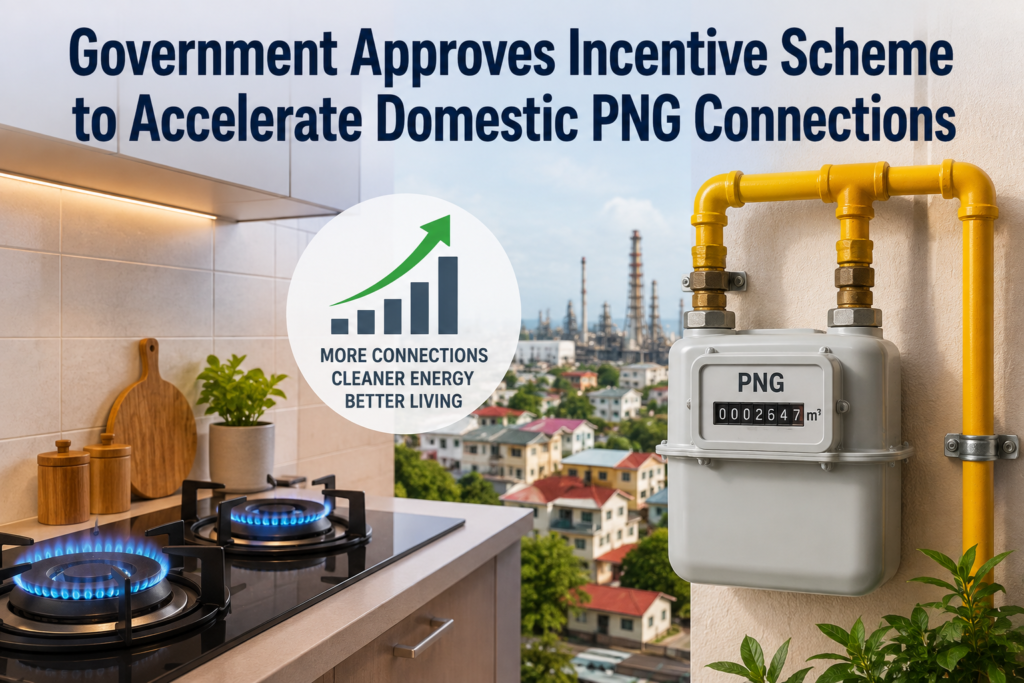
The Government of India has approved an incentive scheme to accelerate the expansion of domestic piped natural gas (PNG) connections, with the objective of making cleaner and more convenient cooking fuel available to a larger number of households across the country. The Incentive Scheme for Promotion of Domestic PNG Connections will come into effect from September 1, 2026.
The scheme is aimed at encouraging City Gas Distribution (CGD) companies to convert existing unbilled or inactive PNG connections into active, billed connections while also expanding pipeline networks into new residential areas. India currently has around 1.74 crore domestic PNG connections, giving the programme a substantial existing base on which to build.
Under the new framework, eligible CGD entities will receive an additional 200 standard cubic metres (SCM) of domestically produced, lower-priced APM gas for every incremental billed domestic PNG connection achieved above the prescribed threshold for their respective geographical areas. The incentive will be implemented in two tranches over a six-month performance period.
The additional allocation of relatively lower-cost domestic gas is intended to improve the economics of expanding household PNG networks. According to the government, the resulting reduction in gas-sourcing costs could bring down the payback period for investments in domestic PNG connections from around 10 years to approximately three years.
The scheme could also have implications for the wider CGD industry. By improving the economics of domestic connections, the policy is expected to encourage companies to deploy capital more aggressively in pipeline infrastructure and customer acquisition. Market participants have already viewed the announcement positively, with shares of major city-gas distributors including Indraprastha Gas, Mahanagar Gas and Adani Total Gas gaining following the government’s decision.
The scheme marks another step in India’s push to expand city gas distribution infrastructure and household access to piped natural gas. Its effectiveness will ultimately depend on how quickly CGD companies convert the incentives into new connections, network expansion and sustained household gas consumption.
