


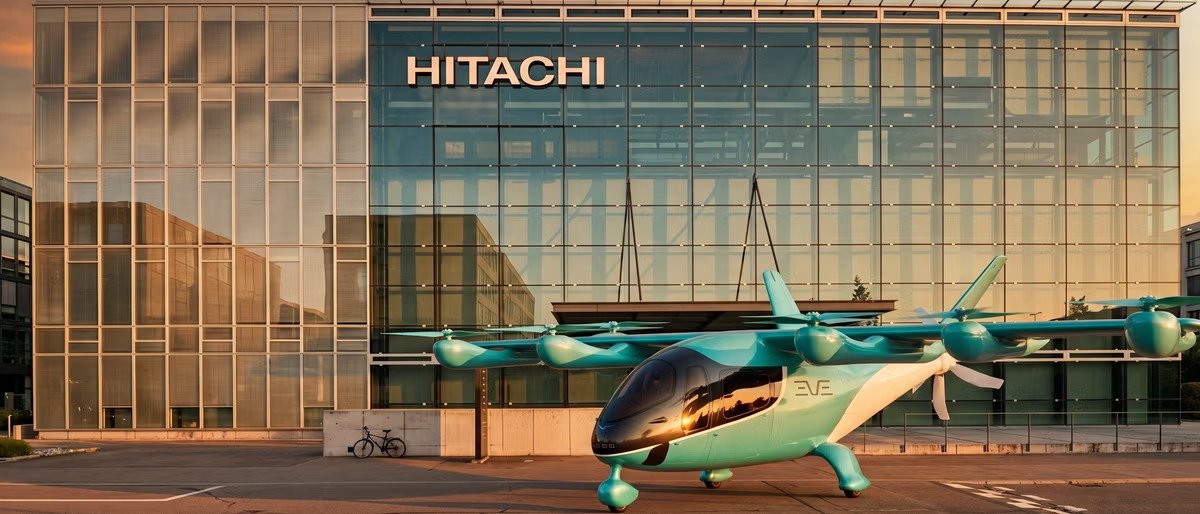
Hitachi Energy, a global technology leader in electrification, and Eve Air Mobility, an Embraer-backed electric vertical takeoff and landing (eVTOL) aircraft manufacturer, have signed a Memorandum of Understanding to advance the electrical infrastructure needed to support urban air mobility at scale.
As Urban Air Mobility (UAM) moves closer to commercialization, one of the key challenges is ensuring that vertiports can be reliably connected to the power grid and equipped to handle high-demand, high-frequency operations. This includes enabling robust and sufficient power capacity, managing fast-charging cycles, and integrating new demand into existing energy systems.
The agreement brings together complementary expertise from the energy and aerospace sectors. Eve is advancing an eVTOL aircraft and a broader UAM portfolio of solutions, including aftermarket services, while Hitachi Energy provides its expertise and innovative technologies in grid integration, power electronics, and charging infrastructure to support the scalable deployment of these systems.
The companies will assess the requirements for enabling vertiport operations, including power availability and high-power charging for eVTOL aircraft. Hitachi Energy will leverage its Grid-eMotion® charging infrastructure, already deployed globally and adapted to the specific requirements of eVTOL operations. The solution optimizes power usage and ensures reliable energy and stable performance for eVTOL high-demand application.
The collaboration will also explore the potential to repurpose aircraft batteries for energy storage after their aviation lifecycle, thereby enhancing the overall ecosystem’s sustainability. The agreement also establishes a path for joint business modeling and coordinated customer engagement to enable the global scale-up of urban air mobility infrastructure.
Commenting on the collaboration, Johann Bordais, Chief Executive Officer of Eve Air Mobility, said that building a successful urban air mobility ecosystem requires cross-industry collaboration. He noted that as the sector advances toward commercial operations, understanding how charging infrastructure, grid connectivity, and vertiport energy requirements integrate into existing networks is becoming increasingly important. According to Bordais, the collaboration with Hitachi Energy supports Eve’s efforts to help enable the infrastructure needed for safe, efficient, scalable, and economically sustainable eVTOL operations worldwide.
Marco Berardi, Head of Grid & Power Quality Solutions and Service at Hitachi Energy, said that the company is addressing the growing challenge of balancing rising electricity demand while decarbonizing power systems. He emphasized that collaboration is essential to achieving the energy transition and expressed confidence that the partnership with Eve Air Mobility will help accelerate the decarbonization of urban air mobility.
Eve Air Mobility, listed on the New York Stock Exchange (NYSE: EVEX and EVEXW) and on Brazil’s B3 (B3: EVEB31), is developing an eVTOL aircraft, with certification and commercial operations expected in 2028. Backed by Embraer’s 56-year aerospace legacy, the company holds letters of intent for about 2,700 eVTOLs from customers worldwide, signaling strong demand for a new urban transportation model.
Hitachi Energy is making significant investments to meet the growing demands of electrification and grid modernization. This includes more than $9 billion USD to expand R&D, manufacturing capacity, engineering, and strategic collaborations.
By combining Eve’s aircraft innovation with Hitachi Energy’s grid connection expertise and technologies, the agreement sets the foundation for a collaborative effort to enable clean, connected, and resilient urban mobility.
