



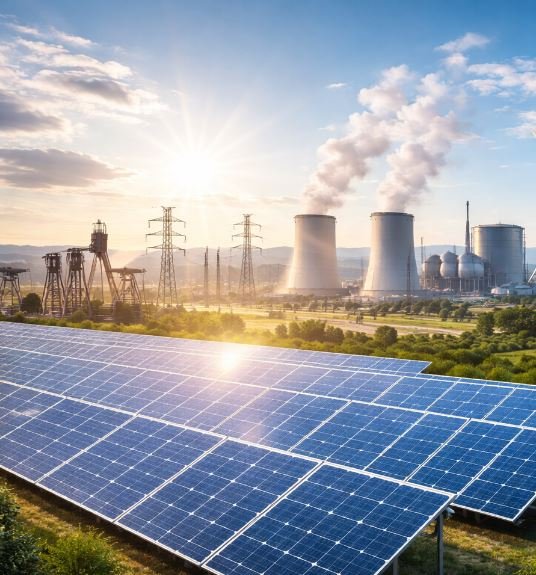
Global energy demand growth slowed to 1.3% in 2025 amid economic and geopolitical uncertainties, while electricity consumption continued to expand at a significantly faster pace of around 3%, according to the latest Global Energy Review by the International Energy Agency (IEA). Solar photovoltaic (PV) emerged as the largest contributor to global energy supply growth for the first time, followed by natural gas.
The report highlights that despite a deceleration compared to 2024, electricity demand remained robust, growing at more than twice the rate of overall energy demand. This growth was driven by increased consumption across buildings and industry, alongside rising demand from electric vehicles and data centres.
Solar PV accounted for over 25% of the increase in global energy supply in 2025, marking a historic milestone as the first modern renewable source to lead primary energy supply growth. Natural gas contributed 17% to the increase, reflecting its continued importance in power generation. Collectively, renewables and nuclear energy met nearly 60% of the total growth in energy demand, with their combined power generation exceeding the rise in global electricity demand.
The slowdown in overall energy demand growth, down from higher levels in 2024 and slightly below the previous decade’s average of 1.4% was attributed to weaker global economic performance, milder weather conditions in certain regions, and accelerated adoption of energy-efficient technologies.
Global oil demand rose modestly by 0.7%, aligning with IEA projections. This growth was constrained by the rapid expansion of electric vehicles, with sales increasing by over 20% in 2025 to exceed 20 million units, representing approximately 25% of all new car sales globally.
Coal demand trends varied across regions. In China, strong renewable energy growth reduced coal use in power generation, while in the United States, higher natural gas prices led to increased coal consumption through gas-to-coal switching. Overall, global coal demand growth slowed during the year.
Regionally, energy demand trends diverged. The United States recorded one of its highest growth rates this century, excluding post-recession periods driven by data centre expansion, industrial activity, and colder winter temperatures. China remained the largest contributor to global energy demand growth, though its growth rate declined sharply to 1.7%, supported by renewable expansion and improved energy efficiency.
India’s energy-related carbon dioxide (CO2) emissions remained flat for the first time since the 1970s, excluding the pandemic period, largely due to the impact of a strong monsoon season. Globally, CO2 emissions growth slowed to 0.4% in 2025. Notably, emissions in advanced economies rose by 0.5%, outpacing the 0.3% increase in emerging and developing economies for the first time since the 1990s, partly due to higher fossil fuel use during colder weather.
In the power sector, solar PV generation increased by an additional 600 terawatt-hours in 2025—the largest annual increase ever recorded for any electricity generation technology. This contributed to a global decline in coal-fired electricity generation. Battery storage emerged as the fastest-growing technology, with approximately 110 gigawatts of new capacity added, surpassing previous records for natural gas capacity additions. Additionally, over 12 gigawatts of new nuclear capacity began construction, signalling renewed momentum in nuclear energy development.
The IEA report also notes that cumulative deployment of low-emission technologies since 2019 is now offsetting fossil fuel consumption equivalent to the total energy demand of Latin America annually. Technologies such as solar PV, wind power, and heat pumps are collectively reducing natural gas demand by an amount equal to roughly half of global annual LNG exports.
IEA Executive Director Fatih Birol emphasized that electrification remains a defining trend in the global energy landscape, with solar PV leading supply growth and natural gas following closely. He noted that countries focusing on resilience and diversification will be better positioned to navigate market volatility and ensure secure, affordable energy in the future.
