


Hydropower production across the southwestern United States has come under increasing pressure as persistent drought conditions continue to deplete water reserves in the Colorado River Basin.
The decline in water availability has affected electricity generation at major hydroelectric facilities, particularly those dependent on the Lake Powell and Lake Mead reservoirs.
These reservoirs support power generation through the Glen Canyon and Hoover dams, which are important sources of electricity for the region.
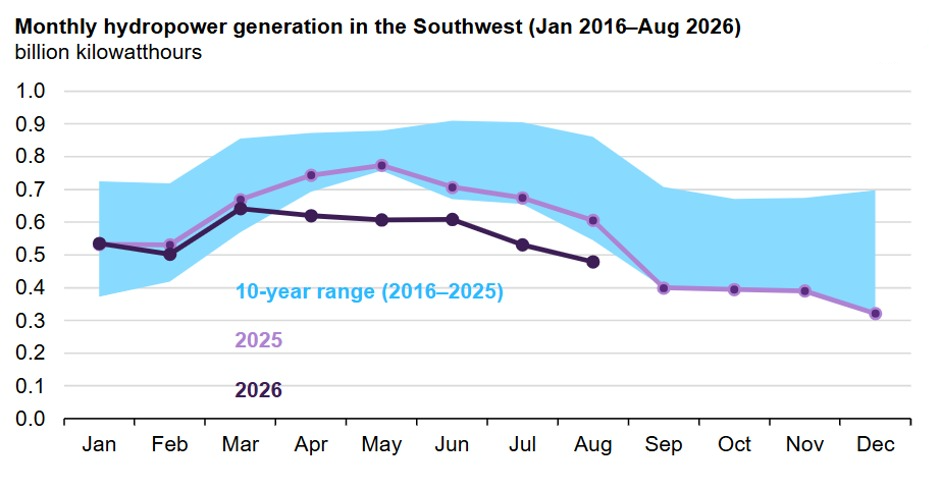
According to the latest electricity generation data from the US Energy Information Administration (EIA), hydropower output in the region fell 19 per cent between April and August 2026 compared with the same period last year.
It was also 28 per cent below the average recorded over the previous 10 years, marking the lowest summer generation level on record.
The shortage of water has brought two major reservoirs close to the minimum levels needed to operate their associated hydroelectric facilities.
Lake Powell, which supplies water to Glen Canyon Dam, had a water elevation of 3,518 feet at the end of September, only 28 feet above the minimum level of 3,490 feet required for power generation.
Lake Mead, which supports electricity production at Hoover Dam, stood at 1,038 feet, against its minimum operating threshold of 950 feet.
To prevent Lake Powell from dropping below the level required for electricity production, authorities released additional water from the Flaming Gorge reservoir in the Upper Colorado River Basin.
They also reduced water releases from Lake Powell to help maintain its elevation at or above 3,510 feet.
However, restricting releases from Lake Powell could affect water availability downstream at Lake Mead, creating further challenges for electricity generation at Hoover Dam.
In response, the US Department of the Interior decided to reduce the combined annual water consumption of California, Arizona and Nevada by 1.25 million acre-feet over the next two years.
The EIA’s November 2026 Short-Term Energy Outlook projects hydropower generation in the Southwest at 6.13 billion kilowatt-hours (BkWh) for 2026, 9 per cent lower than the previous year and 24 per cent below the 10-year average.
Output is expected to decline further marginally to 6.1 BkWh in 2027.
The agency said the El Niño weather pattern could bring higher-than-normal rainfall this year, offering some relief to drought-affected areas and improving the region’s hydropower outlook.
However, improved precipitation over a single year may not be sufficient to reverse the impact of prolonged water shortages. Hydropower is projected to contribute around 4 per cent of total electricity generation in the southwestern US in 2026, considerably lower than its peak share of 8 per cent recorded in 2011
