



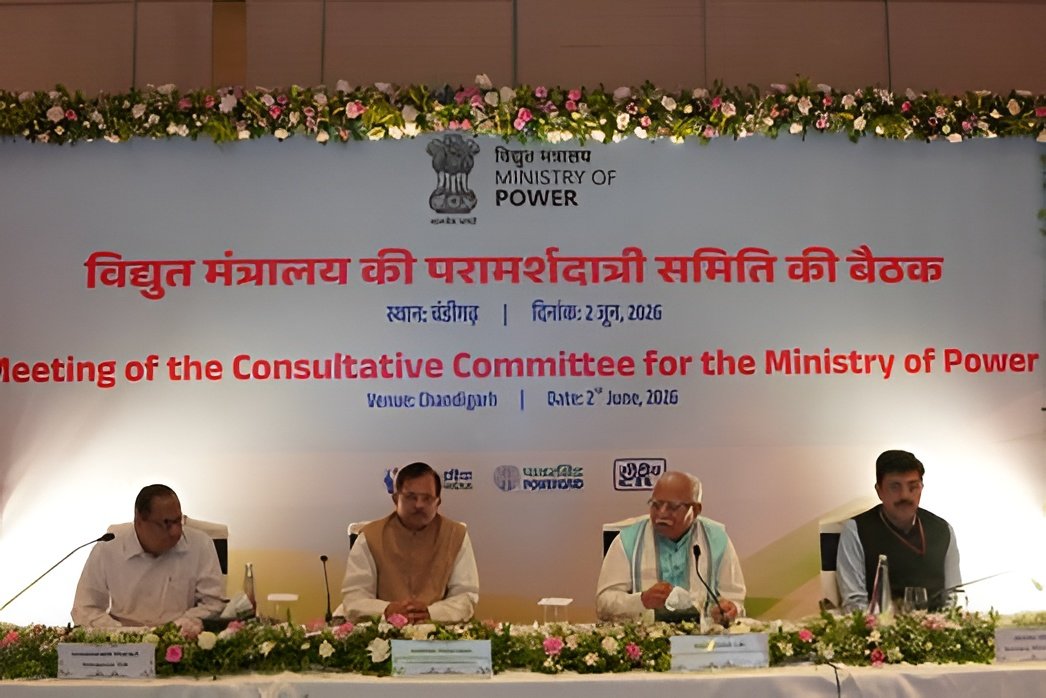
The Consultative Committee meeting for the Ministry of Power, was held Yesterday in Chandigarh. The meeting on the subject of ‘Grid Stability’ was chaired by Shri Manohar Lal, Union Minister for Power.
The meeting was attended by the Shri Shripad Yesso Naik, Minister of State for Power, Member of Parliaments (MPs) who are members of the Consultative Committee, Secretary, Ministry of Power, and senior representatives from key power sector institutions including the Central Electricity Authority, Grid Controller of India Limited and Central Transmission Utility of India Limited.
It was noted that grid stability is central to energy security and that India’s clean energy transition must be supported by a reliable, flexible and resilient power grid.
Members appreciated the initiatives already being taken, including resource adequacy planning, ancillary services, energy storage promotion, deployment of STATCOMs and synchronous condensers, PMU-based monitoring, black-start mock drills, and strengthening of technical standards. Committee appreciated the record renewable capacity integration of renewable capacity of more than 50 GW in a year.
Members also appreciated a series of strategic actions aimed at maintaining grid stability amid the increasing penetration of inverter-based renewable energy resources and growing bulk power demand.
Among the measures discussed were efforts to avoid mismatches between the commissioning of transmission infrastructure and renewable energy generation projects to minimise curtailment, and the promotion of pumped storage projects to provide long-duration energy storage, enhance resource adequacy, and offer inertial support to the grid.
The Committee further supported the development of bulk consumer loads near large renewable energy generation hubs to optimise transmission investments and improve system efficiency. It also welcomed the planned deployment of grid-support equipment such as STATCOMs and synchronous condensers to strengthen voltage stability and overall system performance.
Discussions also focused on establishing appropriate regulatory and commercial frameworks to leverage flexibility services from renewable energy and storage systems. Members stressed the need for periodic review of technical standards to accommodate emerging technologies, including battery energy storage systems, grid-forming inverters, electrolyzers, and data centre loads.
To strengthen operational discipline, the Committee endorsed enhanced compliance monitoring through periodic self-audits and reporting by grid-connected entities. It also emphasized improving renewable energy forecasting through better weather data, regular calibration and maintenance of weather stations, and the installation of automatic weather stations at renewable energy facilities.
Further, the Committee supported measures to improve grid resilience by strengthening transmission and distribution infrastructure in weather-vulnerable regions, maintaining emergency restoration systems, and expanding black-start capabilities to facilitate faster recovery following disturbances.
Members also discussed the need to develop a comprehensive framework for assessing power quality and harmonics, considering the increasing share of inverter-based generation resources in the electricity mix.
The meeting concluded with a collective commitment to advancing a clean, reliable, flexible, secure and resilient power grid that can effectively support India’s growing energy needs and renewable energy ambitions.
