


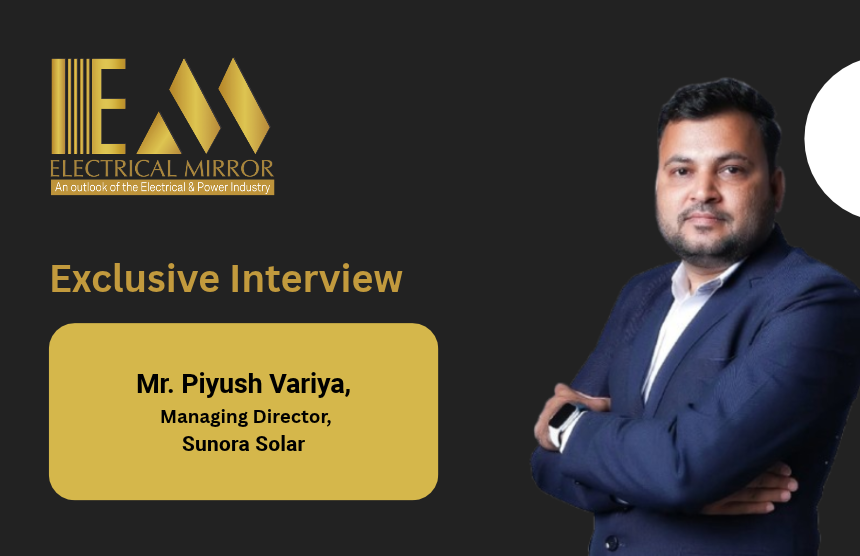
“At Sunora, we are already focusing on advanced N-Type TOPCon and bifacial technologies. Our product portfolio includes high-efficiency modules up to 650 Wp, and we are continuously working on technology upgrades, manufacturing capabilities and product development to meet the changing requirements of the Indian solar market.”
Sunora Solar offers N-Type TOPCon and bifacial solar modules across its product portfolio. What technology developments do you expect to shape the next generation of solar modules, and how is Sunora preparing for them?
We believe the next generation of solar modules will be driven by higher-efficiency N-Type technologies, improved bifacial performance, better temperature and low-light performance, and continued improvements in reliability and module durability.
At Sunora, we are already focusing on advanced N-Type TOPCon and bifacial technologies. Our product portfolio includes high-efficiency modules up to 650 Wp, and we are continuously working on technology upgrades, manufacturing capabilities and product development to meet the changing requirements of the Indian solar market.
Our upcoming manufacturing expansion will further strengthen our ability to adopt new technologies and scale advanced solar products. Our objective is not only to increase wattage, but to deliver better lifetime generation, reliability and overall value to customers.
The company’s product portfolio includes modules ranging up to 650 Wp, along with on-grid and hybrid inverters. How is Sunora balancing higher module efficiency with reliability, cost competitiveness and long-term performance?
For us, higher efficiency is important, but efficiency alone is not the definition of a good solar module. The real objective is to provide maximum energy generation over the complete life of the project.
We therefore focus on balancing efficiency with product quality, reliability, manufacturing consistency and cost. Our modules are developed with internationally recognised testing and certification standards, including IEC standards, BIS and ISO quality-management systems.
We also look at factors such as degradation, temperature performance, mechanical strength and long-term reliability. This approach helps us provide customers with a better combination of performance, return on investment and long-term value.
Hybrid inverters are becoming increasingly relevant as rooftop solar moves towards energy storage and backup applications. How does Sunora view the growth of hybrid solar-plus-storage solutions in India?
We see hybrid solar-plus-storage as an important next phase of India’s rooftop solar growth.
Customers are increasingly looking beyond simply generating solar power. They also want energy independence, backup during power interruptions and better utilisation of the electricity generated during the day.
Hybrid systems can combine solar generation, battery storage and grid power in a single solution. This is particularly relevant for residential customers, small businesses and C&I consumers where reliability and energy management are important.
Sunora’s focus is to provide solutions that can evolve with customer requirements—from conventional rooftop solar today to integrated solar-plus-storage solutions tomorrow.
Sunora Solar has developed solutions for residential rooftops, C&I rooftops, solar parks and solar pumps. Which of these segments do you see contributing most significantly to the next phase of India’s distributed solar growth?
We believe the next phase of distributed solar growth will come from a combination of residential and C&I rooftop segments, with solar pumps also playing an important role in rural and agricultural applications.
Residential solar has enormous potential because of increasing consumer awareness and the growing demand for lower electricity bills and energy independence. At the same time, C&I customers have strong economic reasons to adopt solar because electricity costs directly affect their operating expenses.
Solar pumps can also create significant impact by supporting clean and reliable energy for agriculture.
Therefore, rather than depending on one segment, Sunora is building a diversified portfolio covering residential rooftops, C&I projects, solar parks and solar pumping solutions.
Quality, testing and long-term module performance are becoming increasingly important for developers and consumers. What quality-control measures and certifications does Sunora rely on to ensure product reliability throughout the project lifecycle?
Quality is one of the most important pillars of Sunora’s approach.
We follow established testing and certification standards for our modules. Our certifications and standards include IEC 61215, IEC 61730, IEC 62804, IEC 62716 and IEC 61701, along with BIS certifications and ISO 9001:2015, ISO 14001:2015 and ISO 45001:2018 certifications.
Our testing approach also covers areas such as mechanical load, safety, wet leakage and reliability testing.
The objective is to ensure that the module performs reliably not only when it leaves the factory, but throughout its operating life. We believe strong quality control ultimately protects the customer’s generation, investment and long-term return.
Sunora’s “Solar Intelligent” initiative focuses on awareness, training, technical assistance and helping customers understand their solar requirements. What role do you believe education and after-sales support will play in accelerating solar adoption across Tier-2, Tier-3 and emerging markets in India?
Education and after-sales support will play a very important role in India’s next phase of solar adoption.
In Tier-2, Tier-3 and emerging markets, many customers are interested in solar but may not have complete technical knowledge about system sizing, module selection, inverter requirements, installation and long-term maintenance.
This is where initiatives such as Solar Intelligent can create real value. Our role should not be limited to selling a product. We should help customers understand which solution is right for their application and explain the expected generation, savings and long-term benefits.
Strong technical support, training of channel partners and installers, and responsive after-sales service can build customer confidence. Once customers have a positive experience with solar, they also become an important source of referrals and awareness in their communities.
Our vision is therefore to make solar easier to understand, easier to adopt and more reliable for customers across India.
