


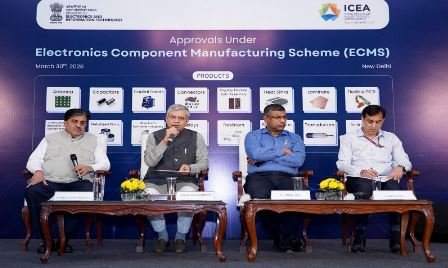
The Ministry of Electronics and Information Technology (MeitY) has approved 29 additional proposals under the Electronics Components Manufacturing Scheme (ECMS), entailing a projected investment of ₹7,104 crore and an estimated production value of ₹84,515 crore.
The newly approved proposals span 16 products with cross-sectoral applications across mobile manufacturing, telecom, consumer electronics, automotive, strategic electronics, and IT hardware. These include display modules as sub-assemblies; key electronic components such as antennas, capacitors, connectors, heat sinks, Li-ion cells, relays, resistors, transducers, SMD passives, flexible PCBs, and inductors; as well as critical supply chain items like laminates, metallized films for capacitors, and rare earth permanent magnets. Capital goods and their components have also been included.
Significantly, the approvals mark the establishment of the country’s first SMD passive plant for tantalum-based capacitors, the first flexible PCB manufacturing facility, and the first rare earth permanent magnet production unit.
Speaking on this occasion, Union Minister for Electronics and Information Technology, Shri. Ashwini Vaishnaw outlined four core priority areas for electronics manufacturing. First, he emphasized the need to build strong in-house design capabilities, either independently or through collaborations with other companies, universities, or institutions, to ensure deeper value capture within the country. Second, he called for the development of a robust domestic supply chain, including through coordinated buyer-seller arrangements, suggesting possible preference for indigenous capital equipment manufacturers, so that domestic manufacturers get more opportunities. Third, he stressed the importance of implementing Six Sigma quality programmes through industry-wide collaboration to ensure global competitiveness and high standards. Fourth, he underscored the need for a structured workforce development initiative, suggesting the establishment of 4–5 focused training centres, each with the capacity to train at least 5,000 individuals, to create a steady pipeline of skilled manpower for the sector.
Shri S. Krishnan, Secretary (MeitY) remarked that ECMS has seen one of the most successful launches, invoking great interest from the industry that the government has matched with faster approvals. He said that the government now expects the industry to match the same with speed of implementation. He emphasized that opportunities remain open, particularly in capital equipment and upstream supply chains, and urged stakeholders to leverage the scheme to build resilient, diversified supply chains, given the present geopolitical situation.
Shri. Pankaj Mahindroo, Chairman, India Cellular & Electronics Association (ICEA) welcomed the enhanced ECMS outlay in the latest Union Budget. He said that the announcement to increase ECMS outlay to ₹40,000 crore, backed by the PLI scheme’s strong performance in mobile manufacturing, boosts confidence in ECMS’s rapid growth.
Under the sub-assembly category, approvals for display module manufacturing have been granted to Dixon Display Technologies Pvt. Ltd. and Wangda Technologies Pvt. Ltd.
In the components segment, approvals have been extended to multiple companies, including VVDN Technologies Pvt. Ltd. for antennas and heat sinks; Molex (India) Pvt. Ltd., Terminal Technologies, SFO Technologies India Pvt. Ltd., and Amphenol FCI India Pvt. Ltd. for connectors; O/E/N India Ltd., Permanent Magnets Ltd., BG Electrical and Electronics India Ltd., and SFO Technologies India Pvt. Ltd. for relays; Vishay Components India Pvt. Ltd. for capacitors; Munoth Lithium Battery Pvt. Ltd. for Li-ion cells; Vishay Precision Transducers India Pvt. Ltd. for resistors and transducers; TDK India Pvt. Ltd. for inductors; and Syrma Strategic Electronics Pvt. Ltd. for flexible PCBs.
To further strengthen the supply chain ecosystem, approvals have also been granted for copper-clad laminates to Syrma Components Pvt. Ltd. and Ratnaveer Precision Engineering Ltd., metallized films for capacitors to Dhruv Industries Ltd., and rare earth permanent magnets to Lohum Cleantech Pvt. Ltd.—marking the country’s first such project based on rare earth oxide.
Additionally, six entities—Titan Engineering & Automation Ltd., NeST Advanced Technology Development Centre Pvt. Ltd., ASM Technologies Ltd., Indo-MIM Ltd., Bharat FIH Ltd., and IFB Industries Ltd.—have received approvals to develop capital equipment manufacturing capabilities.
The government stated that these approvals will significantly enhance domestic value addition, reduce reliance on imports of critical electronic components, and strengthen India’s position in advanced manufacturing. The ECMS initiative aligns with the Prime Minister’s vision of establishing India as a global hub for electronics manufacturing.
