

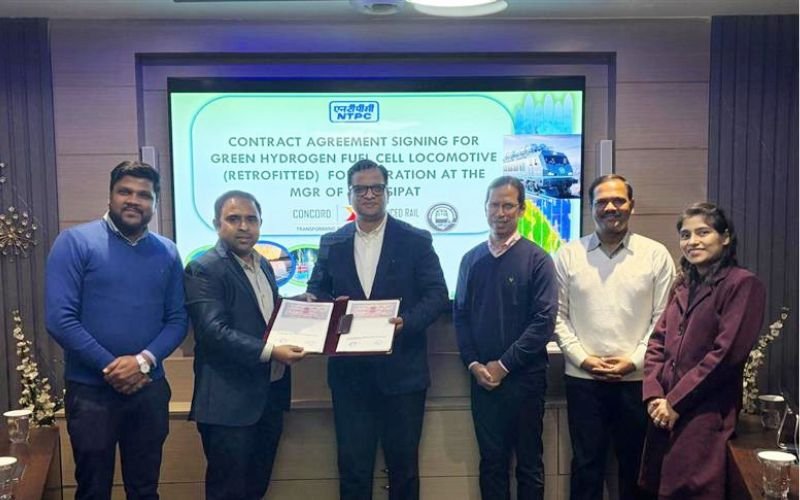
Concord Control Systems Limited has announced a landmark achievement in sustainable rail technology after securing a ₹47 crore order from NTPC Limited for the development of the world’s highest-horsepower hydrogen-fuelled locomotive propulsion system. The project will be executed through Concord’s wholly owned subsidiary, Advance Rail Controls Pvt. Ltd. (ARCPL), in collaboration with Railway Engineering Works.
The initiative involves converting an existing diesel locomotive into a 3,100 HP hydrogen-powered engine, a first-of-its-kind effort globally. Until now, hydrogen rail applications worldwide have remained limited to significantly lower power ranges, making this conversion the highest horsepower hydrogen locomotive project ever attempted. With this move, India becomes the first country to pursue hydrogen propulsion at such a heavy-duty freight scale.
NTPC, India’s largest integrated power utility, has been actively advancing green hydrogen initiatives, and this locomotive project stands out as one of its flagship clean mobility efforts. Unlike experimental prototypes, Concord’s propulsion system is being designed as a commercially viable solution, intended for real-world freight operations and long-term deployment.
Commenting on the development, Gaurav Lath, Joint Managing Director of Concord Control Systems Limited, said the project reflects the company’s commitment to pushing the boundaries of railway innovation. He noted that the hydrogen locomotive marks a critical step toward zero-emission rail transport, beginning in India with global relevance.
Nitin Jain, Joint Managing Director, added that the project highlights the strength of indigenous engineering and public-private collaboration. He emphasized that the combination of hydrogen and battery-based propulsion aligns closely with India’s decarbonisation goals while setting new global standards for sustainable rail systems.
From NTPC’s perspective, the project represents a significant milestone in translating green hydrogen concepts into operational infrastructure. Dr. Ritwick Ghosh of NTPC described the initiative as a transition from vision to execution, underscoring the role of public sector leadership and private sector innovation in advancing India’s energy transition. He also highlighted the project’s potential to address hydrogen offtake challenges while demonstrating practical application.
The hydrogen locomotive initiative aligns with Indian Railways’ objective of achieving net-zero carbon emissions by 2030, well ahead of India’s national net-zero target of 2070. It also resonates with the vision outlined by Union Railway Minister Shri Ashwini Vaishnaw to accelerate the adoption of clean and future-ready rail technologies.
Globally, the announcement comes at a time when major economies are accelerating clean rail strategies. While regions such as the European Union and the United States are targeting net-zero rail emissions by 2050, and several countries are running pilot hydrogen rail projects, India’s entry into high-horsepower hydrogen locomotives positions it as a technology frontrunner rather than a follower.
Beyond domestic deployment, Concord Control Systems is exploring international partnerships across Europe, Japan, Australia, the Middle East, Africa, and North America. The company sees strong potential for exporting hydrogen-based propulsion systems, advanced locomotive electronics, and related subsystems as global demand for clean transport solutions grows.
The NTPC–Concord collaboration strengthens India’s position as a hub for next-generation railway innovation under the Make in India initiative. At the same time, it opens new avenues for clean mobility exports, reinforcing India’s leadership role in shaping the future of zero-emission heavy-duty rail transport worldwide.
