


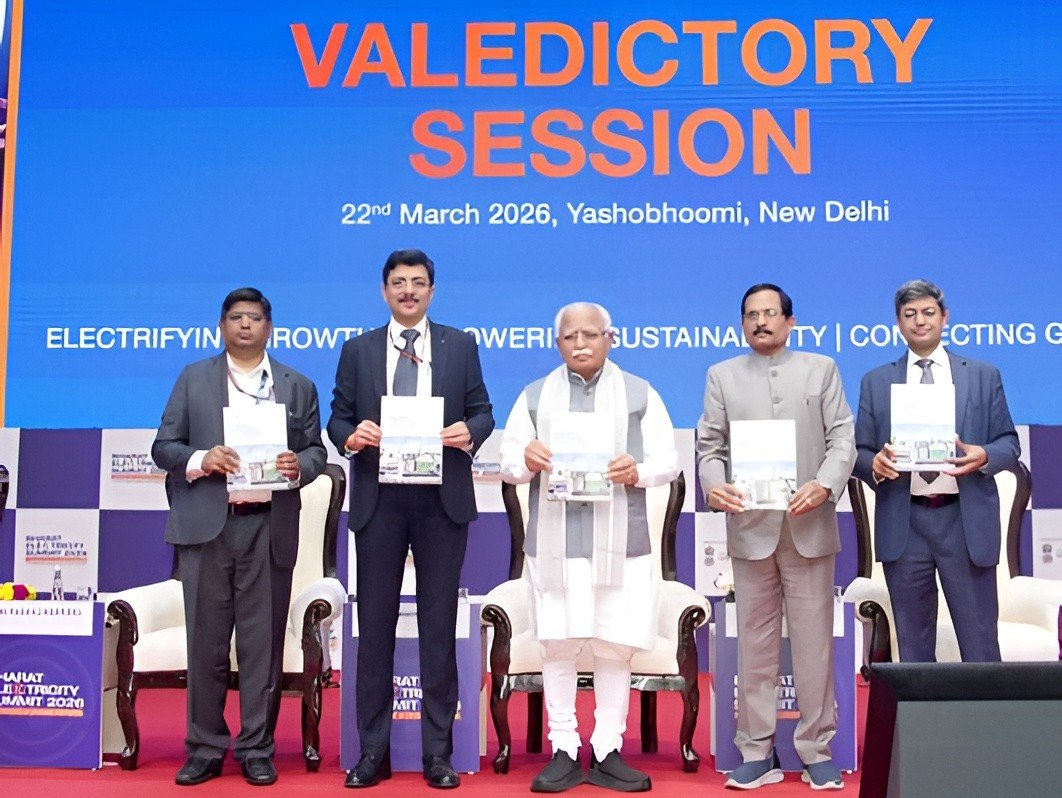
The first edition of the Bharat Electricity Summit (BES) 2026 concluded successfully with strong participation from policymakers, global experts, industry leaders, investors, and innovators, marking a significant step in shaping the future of India’s power sector and accelerating the global clean energy transition. The Summit featured extensive deliberations, bilateral engagements, and business interactions, reinforcing India’s growing leadership in the global energy ecosystem.
The Summit recorded large-scale participation, with over 35,000 exhibition attendees, representation from 28 States and Union Territories, more than 200 exhibiting companies including over 80+ start-ups, over 6,000+ delegates, 300+ speakers, and more than 100+ conference sessions, reflecting the scale and global relevance of the event.
India continues to advance towards its target of achieving 500 GW of non-fossil fuel capacity by 2030, having already crossed 50 percent non-fossil capacity. Initiatives such as One Sun, One World, One Grid were highlighted as key pillars of India’s commitment to global energy cooperation and sustainable growth.
Delivering the valedictory address, Union Power Minister Shri Manohar Lal said the Summit witnessed unprecedented participation despite being the first edition, and resulted in meaningful discussions across all segments of the power sector. He noted that the strong presence of start-ups reflected the growing innovation ecosystem in the electricity sector and would play a major role in future transformation.
The Minister stated that electricity remains a fundamental requirement for achieving the vision of Viksit Bharat by 2047, and recalled that under the Saubhagya scheme, electricity access has been extended to every corner of the country. He emphasised the importance of renewable energy expansion, particularly solar power, and reiterated the Prime Minister’s vision of “One Sun, One World, One Grid,” calling for stronger global cooperation in the energy sector.
He further noted that discussions with several countries, especially African nations, indicated strong opportunities for mutually beneficial cooperation in power generation, transmission, and technology development. He stressed the need to strengthen DISCOMs through reforms including smart metering, operational efficiency, and cost-reflective tariffs, adding that utilities have shown willingness to undertake the required improvements.
The Minister also announced that the next edition of the Bharat Electricity Summit will be held in 2028 in Gandhinagar, Gujarat.
Minister of State for Power and MNRE Shri Shripad Naik said the deliberations demonstrated that India’s power sector is expanding through a coordinated federal framework where national policy and state-level execution are aligned. He highlighted three major insights from the Summit — states are emerging as drivers of innovation, distribution reforms are gaining momentum, and the energy transition is becoming integrated with renewables, storage, transmission, and digital technologies evolving together.
Power Secretary Shri Pankaj Agarwal said industry discussions indicated a capital expenditure pipeline of about ₹32,000 crore by power sector manufacturers. He emphasised the need for system-level cost evaluation to maintain affordability and underlined the urgency of scaling up energy storage capacity for renewable integration. Additional Secretary Shri Piyush Singh also commended the scale and organisation of the Summit.
Three reports were released during the event, including Rating Regulatory Performance of States and Union Territories 2025 by Power Foundation of India, Ash Generation and Utilisation at Coal/Lignite-based Thermal Power Stations 2024-25 by Central Electricity Authority, and Establishing a Sodium-ion Battery Ecosystem in India by the Council on Energy, Environment and Water.
India’s power sector continues to witness rapid expansion, with installed capacity exceeding 520 GW and transmission network crossing five lakh circuit kilometres. Solar capacity has increased from 2.8 GW in 2014 to over 143 GW, while electricity demand is expected to grow by more than 30 percent by 2030 due to emerging sectors such as data centres and electric mobility. The Minister noted that thermal power will remain essential for grid stability while renewable energy, storage, and grid modernisation will drive long-term sustainability.
A ministerial meeting with States and Union Territories identified priority actions including improving DISCOM financial viability, ensuring cost-reflective tariffs with targeted subsidies, accelerating smart metering, securing generation capacity tie-ups, and advancing nuclear power development for long-term energy security.
Strategic sessions during the Summit focused on centre-state coordination, green hydrogen, AI-enabled power systems, nuclear energy, electricity markets, financing frameworks, energy storage, and strengthening domestic manufacturing under Make in India for global clean energy supply chains. Discussions indicated that India’s long-term energy transition could require investments exceeding USD 22 trillion by 2070.
Infrastructure expansion emerged as a key requirement, with over 1.37 lakh circuit kilometres of transmission lines needed by 2030, requiring investments of about ₹9 lakh crore. Energy storage demand is expected to increase sharply, with pumped storage potential exceeding 200 GW and Battery Energy Storage Systems playing a crucial role in peak demand management. The Indian Carbon Market Portal was also launched, with trading expected to begin soon, marking a major step in climate finance development.
Digital transformation was highlighted as a defining trend, with increasing use of artificial intelligence, machine learning, and digital twins for predictive grid operations. The proposed India Energy Stack aims to create interoperable and consumer-centric energy systems, while smart metering and rooftop solar adoption are enabling consumers to become active participants in the energy ecosystem.
States presented ambitious energy roadmaps, including Gujarat targeting 190 GW renewable capacity by 2047, Andhra Pradesh developing a clean energy hub with investments exceeding ₹6 lakh crore, Maharashtra projecting demand of 280 TWh by 2030, Bihar focusing on storage and grid expansion, and Delhi moving towards a high-renewable, storage-integrated urban power system.
The Summit also hosted high-level bilateral meetings with countries including Malawi, Tajikistan, Mauritius, Kyrgyzstan, and Russia, along with international organisations such as Africa50. Discussions focused on cross-border power trade, renewable collaboration, transmission infrastructure, capacity building, and technology transfer, with the India-Africa Strategic Meet strengthening partnerships in clean energy and grid modernisation.
On the business front, more than 1,200 buyer–seller meetings were conducted, generating business enquiries worth over ₹517 crore.
The Bharat Electricity Summit 2026 concluded with a clear roadmap for a resilient, technology-driven, and investment-friendly power sector. The outcomes of the Summit are expected to support policy development, strengthen global partnerships, and accelerate the transition towards a reliable, affordable, and clean energy future for India and the Global South.
