


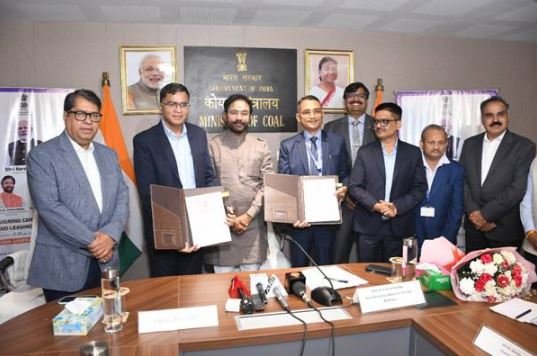
In a significant boost to India’s coal gasification ambitions, Bharat Coal Gasification and Chemicals Limited (BCGCL) and Mahanadi Coalfields Limited (MCL) have signed a landmark land leasing agreement for a Coal-to-Ammonium Nitrate project at Lakhanpur, Odisha. The agreement was formalised in New Delhi in the presence of Union Minister of Coal and Mines, Shri G. Kishan Reddy.
The project, designed as a 2,000 tonnes per day (TPD) Ammonium Nitrate facility, marks a major milestone as India’s first coal gasification initiative to utilise indigenously developed technology by Bharat Heavy Electricals Limited (BHEL). It underscores the country’s push towards technological self-reliance and reduced dependence on imported solutions in the energy and chemical sectors.
Spanning approximately 350 acres of land under MCL’s possession, the project has been facilitated by recent policy reforms introduced by the Ministry of Coal. These reforms allow the utilisation of Coal Bearing Area (CBA) land for gasification projects, enabling value-added use of domestic coal resources and supporting sectoral diversification.
The Ministry of Coal has extended financial assistance of ₹1,350 crore under its incentive scheme to promote coal gasification. The project has already gained execution momentum, with key Lump Sum Turnkey (LSTK) packages awarded—LSTK-1 and LSTK-2 to BHEL, and LSTK-3 and LSTK-4 to Larsen & Toubro. Concurrently, site development activities, including boundary wall construction and tree enumeration, are progressing in parallel to maintain project timelines.
Addressing the ceremony, Shri G. Kishan Reddy highlighted that the initiative aligns with the Prime Minister’s vision of Atmanirbhar Bharat and reflects the government’s focused efforts to transform the coal sector. He emphasised the need to leverage India’s abundant coal reserves beyond conventional applications through large-scale coal gasification.
The Minister further stated that the Cabinet has approved an outlay of ₹8,500 crore to promote coal gasification, with seven projects already finalised, including three where bhoomi pujan has been completed. He described the ₹25,000 crore investment in the BCGCL-MCL project as a major step forward, marking BCGCL’s first indigenous venture in this domain.
Underscoring the transformative potential of coal gasification, Shri Reddy noted its role in reducing import dependency and conserving foreign exchange. He called for the adoption of best-in-class global technologies alongside strengthening domestic capabilities, assuring continued government support. He also stressed coordinated efforts across ministries, including MoEF&CC, Ministry of Heavy Industries, and Ministry of Commerce, and urged stakeholders to expedite project execution.
Shri Vikram Dev Dutt, Secretary, Ministry of Coal, termed the agreement a landmark milestone in advancing coal gasification in India. He highlighted that key enablers such as statutory clearances, Letters of Award, and tendering processes are already at advanced stages, positioning the project for timely completion. He urged stakeholders to ensure effective coordination and ownership for successful execution.
On the occasion, the Minister also inaugurated BCGCL’s official website, aimed at enhancing transparency and stakeholder engagement by providing a centralised platform for project-related information and updates.
The land lease agreement is expected to accelerate project implementation and ensure adherence to timelines. The Lakhanpur Coal-to-Ammonium Nitrate project represents a critical step in India’s journey towards technological advancement, policy-driven growth, and self-reliance. It also aligns with the broader vision of Viksit Bharat, promoting innovation, efficient resource utilisation, and sustainable industrial development.
Amid evolving global geopolitical dynamics and supply chain uncertainties, the project assumes strategic importance in strengthening domestic capabilities, enhancing value addition to natural resources, and building a resilient, future-ready economy.
