


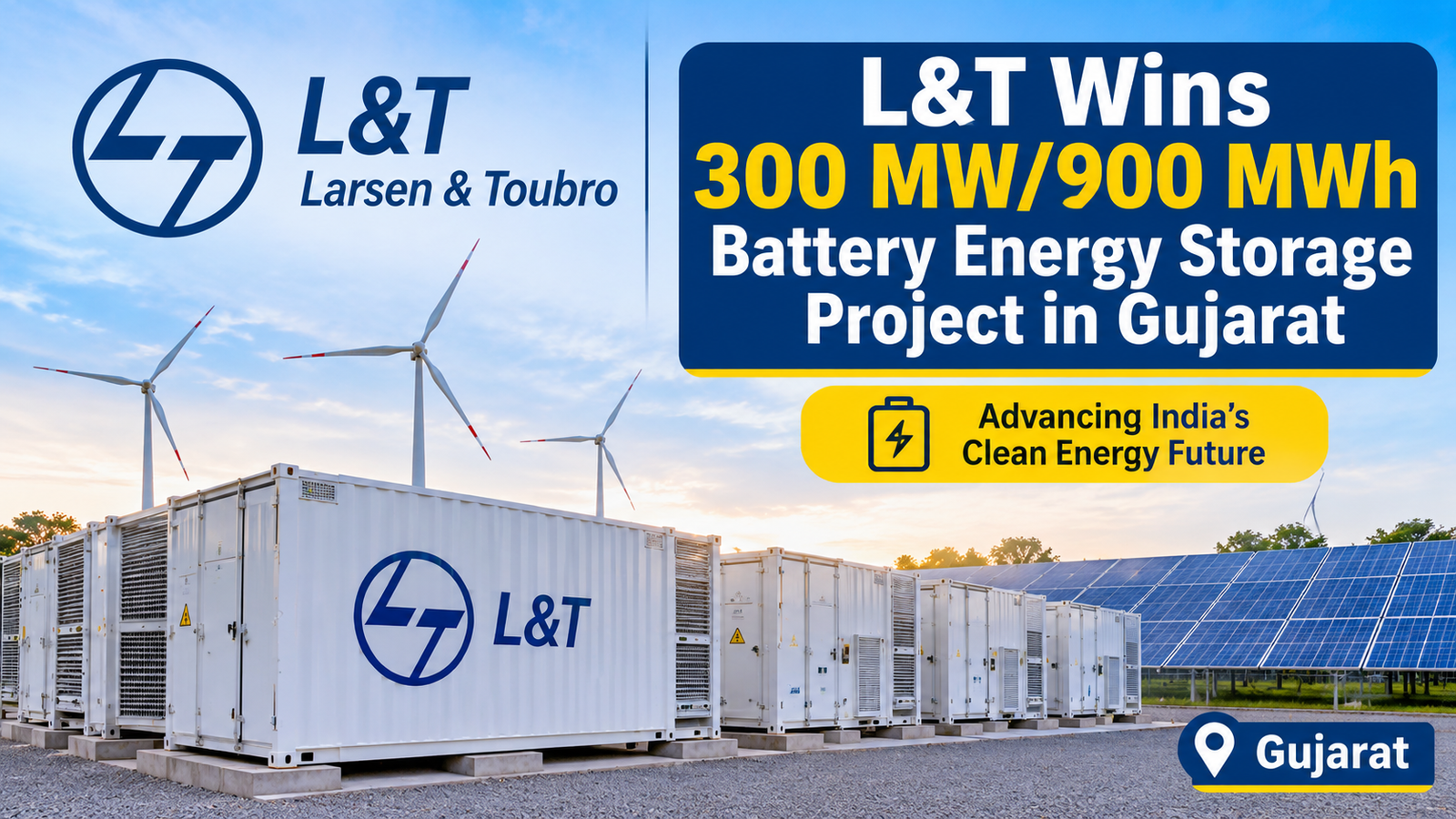
Larsen & Toubro (L&T) has secured a significant order to develop a 300 MW/900 MWh Battery Energy Storage System (BESS) at Khavda in Gujarat, strengthening its presence in India’s rapidly expanding energy storage market. The project will be jointly executed by L&T’s Renewables business and L&T Electronic Products & Systems (LTEPS). Classified as a significant order by the company, the contract falls within the value range of ₹1,000 crore to ₹2,500 crore.
The proposed facility will feature a three-hour battery storage system with a power capacity of 300 MW and an energy storage capacity of 900 MWh. It is designed to store surplus renewable electricity during periods of high generation and supply the stored energy when demand increases. This arrangement is expected to improve the utilisation of renewable power, enhance grid stability and provide greater flexibility in managing fluctuations between electricity generation and consumption.
The project will incorporate advanced liquid-cooling technology to improve the performance and operational efficiency of the battery storage installation. According to L&T, the technology is expected to support higher power density, enhanced safety and a longer operating life. These features are particularly important for utility-scale energy storage facilities, where thermal management and operational reliability play a critical role in maintaining system performance.
The Khavda project comes at a time when India is expanding its renewable energy generation capacity, increasing the need for infrastructure capable of managing variable electricity output. Solar and wind generation depend on weather conditions and natural resource availability, which can result in differences between the timing of electricity generation and consumer demand. Battery energy storage systems help address this challenge by absorbing excess electricity when renewable generation is high and releasing it during periods of peak demand or lower generation.
The integration of the 300 MW/900 MWh storage facility is expected to support greater flexibility in the power network and enable more effective integration of renewable electricity. By providing the ability to shift stored energy across different demand periods, the system can help utilities manage peak-load requirements and improve the reliability of electricity supply.
Khavda has emerged as an important location in India’s renewable energy development landscape, with large-scale solar and wind power projects contributing to the expansion of clean electricity generation in Gujarat. As renewable capacity increases in the region, the development of supporting infrastructure, including energy storage and transmission systems, is becoming increasingly important for efficient power evacuation and grid management.
For L&T, the order brings together its renewable energy engineering capabilities and electronic products and systems expertise for the development of a large-scale storage project. The joint execution by its two business verticals reflects the company’s focus on expanding its participation in emerging power infrastructure segments, particularly technologies supporting renewable energy integration and electricity grid modernisation.
The order also reflects the growing importance of battery storage in India’s electricity sector as distribution utilities, renewable energy developers and power infrastructure companies seek solutions to manage intermittent generation and changing demand patterns. As the deployment of solar and wind projects accelerates, utility-scale BESS installations are expected to play an increasingly important role in supporting grid flexibility, energy balancing and dependable power supply.
With this latest contract, L&T has further strengthened its position in India’s energy storage segment, adding to its involvement in the development of infrastructure required for the country’s transition towards a more renewable-based electricity system.
