


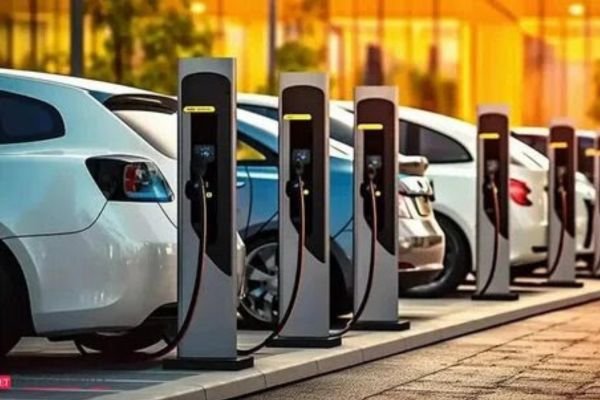
India’s electric vehicle (EV) public charging network continues to grow steadily under the FAME-II scheme, with 6,645 public EV charging stations operational across the country as of 1 March 2026 against 9,332 sanctioned, the Ministry of Heavy Industries informed Parliament on Friday.
The Ministry of Heavy Industries stated that the deployment of charging stations is being carried out based on feasibility, demand, and expected utilization. States such as Maharashtra and Uttar Pradesh have seen significant installations. Maharashtra has 615 operational chargers against 670 sanctioned, while Uttar Pradesh has 456 operational chargers out of 937 approved.
The expansion is part of a broader push to strengthen India’s EV ecosystem through coordinated policy and infrastructure development. The Ministry of Power issued the Guidelines for Installation and Operation of Electric Vehicle Charging Infrastructure-2024 in September 2024, aimed at establishing a connected and interoperable charging network. Additionally, the Bureau of Indian Standards (BIS) has introduced technical standards governing safety, connectors, communication protocols, Electric Vehicle Supply Equipment (EVSE), and battery swapping systems.
To further ensure interoperability across vehicles, the Ministry of Road Transport and Highways (MoRTH) has also amended AIS standards to define technical requirements for vehicle inlet connectors, particularly for M (passenger) and N (goods) categories, excluding N1 category goods vehicles up to 3.5 tonnes gross vehicle weight.
State-wise data shows a wide distribution of EV charging infrastructure. Tamil Nadu leads with 957 operational chargers, followed by Uttar Pradesh (937), Karnataka (751), and Maharashtra (670). Other states with significant numbers include Gujarat (530), Haryana (539), Rajasthan (543), Telangana (488), and West Bengal (448). Several regions, including Andaman & Nicobar Islands, Chandigarh, Sikkim, and Lakshadweep, currently report no operational chargers.
Apart from Oil Marketing Companies (OMCs), other public sector entities have also contributed to the charging infrastructure. Collectively, these entities have installed 227 EV charging stations. This includes CESL (97), REIL (49), KSEB (30), SMC (50), and POWERGRID (1).
The Ministry reiterated that the charging network is being developed as part of a national strategy to support EV adoption, with a focus on standardization, interoperability, and accessibility across urban and semi-urban regions.
This information was shared by the Minister of State for Heavy Industries, Shri Bhupathiraju Srinivasa Varma, in a written reply in the Rajya Sabha.
