



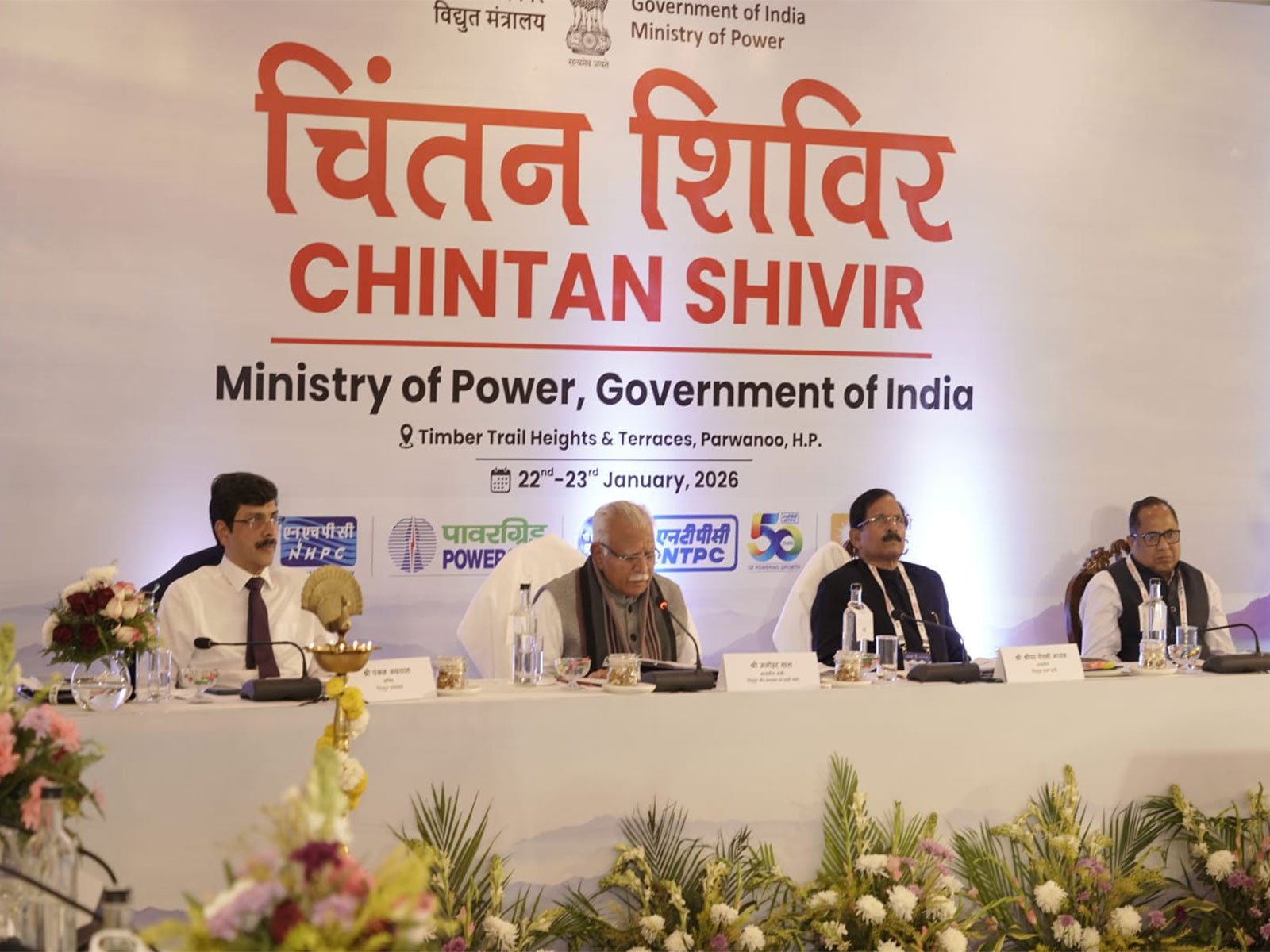
The two-day Chintan Shivir–2026 of the Ministry of Power concluded on Friday, at Parwanoo, Himachal Pradesh, with wide-ranging deliberations on reforms and the future roadmap of India’s power sector. During the conclave, Union Minister of Power and Housing & Urban Affairs Shri Manohar Lal released the Central Electricity Authority (CEA) report on the Roadmap to 100 GW of Hydro Pumped Storage Projects (PSPs) by 2035–36 and the 14th Integrated Rating and Ranking Report of Power Distribution Utilities.
The Chintan Shivir, held on January 22–23, was convened to reflect on key challenges and collectively chart the future course of India’s power sector in line with the vision of Viksit Bharat @ 2047. The event saw participation from Union Minister of State for Power and New & Renewable Energy Shri Shripad Naik, Secretary (Power), senior officials from the Ministry of Power, CEA, Central Electricity Regulatory Commission (CERC), CPSEs, State governments, State Electricity Regulatory Commissions (SERCs), and industry leaders, experts, and academicians.
In his inaugural address, Shri Manohar Lal highlighted the achievements of India’s power sector while underlining the need to confront persistent challenges. He stressed that India’s long-term economic vision requires a robust, sustainable electricity sector capable of delivering reliable, affordable, and clean power.
Deliberations over the two days focused on critical policy and reform areas, including the Draft Electricity Amendment Bill, 2026; the Draft National Electricity Policy, 2026; acceleration of nuclear power development; long-term reform measures in the distribution sector; optimization of transmission, distributed energy resources and storage to reduce costs and achieve the 300 GWh storage target by 2030; and measures to minimize litigation through de-regulation and systemic improvements.
Participants engaged in open and holistic discussions aimed at restoring the financial health of the power sector, promoting ease of doing business, reducing avoidable litigation, strengthening regulatory accountability, and placing consumers at the centre of the power ecosystem. Practical insights were shared by stakeholders, with emphasis on balancing reform ambitions with ground realities.
On the first day, discussions centred on proposed changes in the Draft Electricity Amendment Bill, 2026, which seeks to address structural inefficiencies in distribution, enhance the financial viability of licensees, improve economic competitiveness, modernise the legal framework, enable energy transition, and strengthen regulatory accountability while safeguarding consumer interests. The draft National Electricity Policy, 2026, was also deliberated, which targets per capita electricity consumption of 2,000 kWh by 2030 and over 4,000 kWh by 2047, a 45% reduction in emissions intensity from 2005 levels by 2030, and net-zero emissions by 2070. Sessions also examined grid resilience, integration of higher shares of renewable energy, consumer-centric services, and fast-tracking nuclear capacity deployment.
On the second day, the focus shifted to ensuring the long-term financial viability of DISCOMs through structural operational, financial, and regulatory reforms. Discussions included rationalisation of cross-subsidies, particularly for manufacturing, railways, and metro systems, to enhance industrial competitiveness and employment generation. Participants also deliberated on challenges and the way forward in optimising transmission systems, distributed energy resources, and storage.
In the concluding session, participants examined measures to reduce litigation in the power sector. It was observed that disputes often arise from a lack of clarity, inconsistent interpretations, and procedural delays. Emphasis was placed on standardisation, digitalisation, and faster decision-making to lower costs for utilities and consumers and improve the investment climate.
During the Shivir, Shri Manohar Lal released the CEA report titled “Roadmap to 100 GW of Hydro Pumped Storage Projects (PSPs) by 2035–36”. The report outlines India’s strategy to meet rising energy storage requirements driven by non-fossil fuel capacity targets of 500 GW by 2030 and 701 GW by 2035. It projects storage needs of 62 GW by 2029–30 and 161 GW by 2034–35, highlighting the growing importance of long-duration storage beyond 2030. The report identifies PSPs as a proven, clean, large-scale, and long-life storage solution using largely indigenous technologies, assesses state-wise potential, proposes a phased capacity addition plan, and recommends policy, regulatory, and implementation measures, with emphasis on off-stream closed-loop projects.
The 14th Integrated Rating and Ranking Report of Power Distribution Utilities was also released on Friday. A total of 65 distribution utilities were rated, of which 31 achieved A+ or A ratings. Torrent Power Ahmedabad and Torrent Power Surat topped the rankings for FY 2024–25, while Uttar Gujarat Vij Company Limited (UGVCL) emerged as the highest-rated state-owned DISCOM.
Concluding the event, Shri Manohar Lal urged all stakeholders to work in close coordination for the time-bound implementation of reforms, emphasising that sustained collaboration among the Centre, States, industry, utilities, and institutions is essential to establish India as a global leader in the power sector.
